The Street Canyon Paradox: Why Tree-Lined Urban Streets Trap Toxic Diesel Exhaust at Stroller Height
Tree-lined streets are sold as a clean-air premium — the physics says otherwise. Where the diesel soot actually settles, and the hedges-vs-canopy decision that changes exposure.
In this article
- 1. The Physics of the "Street Canyon": Recirculation Vortices
- 2. Enter the Tree Canopy: How Leaves Become a Toxic Ceiling
- 3. The Stroller Height Tragedy: 0.5 to 0.8 Meters Above Asphalt
- 4. The Biological Antidote: Low Hedges vs. High Tree Canopies
- 5. Why Conventional Air Quality Maps Miss the Trap
- The HabitatReport Diligence Framework: Calibrating for Micro-Air Reality
The Street Canyon Paradox
Why pollution concentrates differently on “identical” streets — and how tree canopies act as a toxic ceiling.
When prospective home buyers tour a neighborhood, few sights are more instantly reassuring than a lush, tree-lined street. We have been conditioned to equate leafy green canopies with clean air, quiet retreats, and environmental prestige. Real estate listings routinely boast: "Quiet residential street shaded by mature London planes and oak trees."
However, groundbreaking research in atmospheric fluid dynamics and urban microclimatology led by Professor Prashant Kumar (Founding Director of the Global Centre for Clean Air Research at the University of Surrey) alongside public health researchers at Harvard University has revealed a counter-intuitive reality:
In dense urban environments, tall, continuous tree canopies do not filter roadside air pollution—they act as a physical lid that traps toxic vehicle exhaust directly at breathing height.
Under specific architectural conditions, living on a picturesque tree-lined street can expose your family to up to 60% higher concentrations of nitrogen dioxide ($NO_2$) and ultrafine diesel particulate matter ($PM_{2.5}$) than living on an open street with zero trees.
Here is the physics behind the Street Canyon Paradox, why conventional city-wide air quality sensors deceive suburban families, and how informed property buyers evaluate micro-air exposure.
1. The Physics of the "Street Canyon": Recirculation Vortices
In atmospheric science, an urban street flanked by continuous two- to four-storey buildings (such as classic Victorian/Edwardian terraces in the UK, brownstones in New York, or townhomes in European capitals) is classified as an Urban Street Canyon.
The aerodynamic behavior of a street canyon is defined by its aspect ratio:
$$\text{Aspect Ratio} = \frac{H}{W}$$
Where: * $H$ is the average height of the flanking buildings. * $W$ is the street width from facade to facade.
When ambient wind blows across a city at roof level, it rarely sweeps smoothly down into the street. Instead, shear forces create a rotating barrel of trapped air known as a leeward recirculation vortex (skimming flow regime):
- Wind blowing perpendicular to the street skims across the rooftops.
- It hits the windward building facade, cascades downward toward the pavement, sweeps across the road surface, and crawls up the opposite (leeward) wall.
- This circular motion traps vehicular emissions inside the street cavity rather than dispersing them upward into the troposphere.
2. Enter the Tree Canopy: How Leaves Become a Toxic Ceiling
Under normal, tree-less conditions, thermal buoyancy and turbulent street eddies eventually ventilate emissions out of the canyon.
However, when mature deciduous trees with dense foliage are planted along both curbs, their crowns interlock to form an aerodynamic aerodynamic roof. This creates the Street Canyon Paradox:
- Aerodynamic Roughness & Velocity Stagnation:
The dense canopy dramatically increases frictional drag at the top of the canyon, reducing intra-canyon wind velocities by 50% to 80%. The fresh roof-level air can no longer penetrate down to street level to dilute pollutants. - The "Green Lid" Effect:
Combustion exhaust from tailpipes—containing diesel soot, volatile organic compounds (VOCs), and raw nitrogen oxides ($NO_x$)—rises naturally due to thermal exhaust heat. When it strikes the underside of the canopy, the leaves and branches reflect and deflect the plume back down toward the kerbside. - Photochemical Trapping:
Because the tree canopy reduces solar radiation reaching the asphalt, the photochemical breakdown of volatile pollutants is delayed, allowing reactive species to linger in the pedestrian breathing zone for hours.
The net result: a stagnant, concentrated chamber of toxic diesel exhaust circulating endlessly between the pavement and the underside of the leaves.
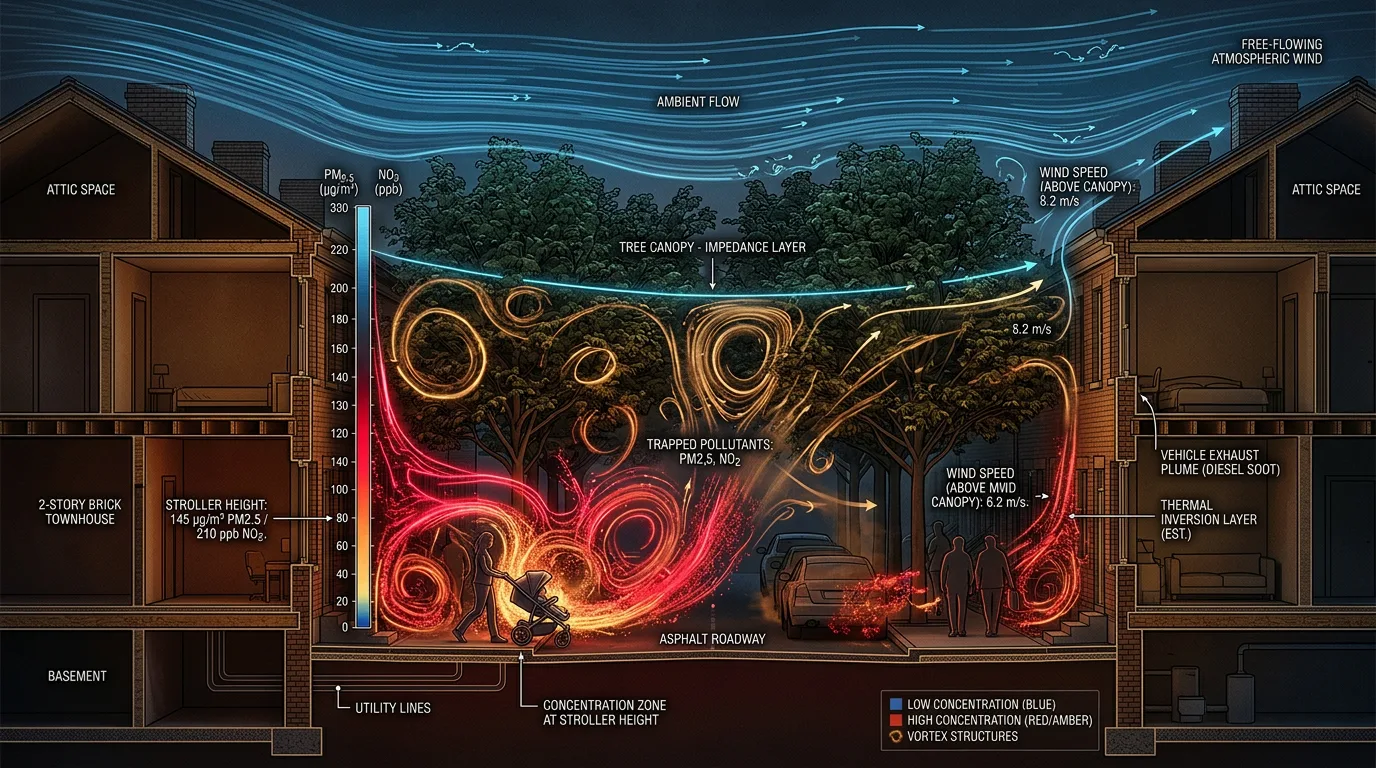
3. The Stroller Height Tragedy: 0.5 to 0.8 Meters Above Asphalt
The most alarming finding of Professor Kumar’s team at GCARE centers on vertical gradient stratification—specifically, who suffers the most severe exposure.
Because vehicular tailpipes discharge emissions between 0.2 and 0.4 meters above the ground, the heaviest concentration of coarse particulates ($PM_{10}$), ultrafine soot ($PM_{0.1}$), and unburned hydrocarbons hovers in the bottom 1-meter layer of the street before slow thermal diffusion occurs.
- Adults (Breathing height ~1.6m – 1.8m): Inhale partially diluted concentrations of the recirculation eddy.
- Infants and Toddlers in Prams/Strollers (Breathing height ~0.5m – 0.8m): Sit directly inside the primary plume trajectory.
Professor Kumar’s empirical measurements across urban UK corridors demonstrated that infants pushed in strollers through tree-lined street canyons are exposed to up to 60% higher particulate counts than their parents walking right beside them. Because infant lungs are still developing and their respiratory rates are double those of adults per kilogram of body weight, the cumulative biological dose is extraordinarily elevated.
4. The Biological Antidote: Low Hedges vs. High Tree Canopies
Does this mean urban vegetation is inherently hazardous? Absolutely not. It means urban planning without fluid dynamics produces catastrophic unintended consequences.
The GCARE research outlines a critical distinction between two types of green infrastructure:
❌ The High Tree Canopy (The Ventilatory Blockade)
- Continuous crown canopy above building eaves.
- Blocks vertical air exchange.
- Traps tailpipe emissions at pedestrian ground level.
✅ Low-Level Dense Hedges (The Aerodynamic Baffle & Filter)
- Chest-height hedges (1.2m to 1.6m) planted directly between the roadway kerb and the footpath (using species like Taxus baccata, Ligustrum, or Euonymus).
- The Physics: Hedges act as a porous mechanical baffle that disrupts the lateral dispersion of tailpipe plumes from the roadway toward the footpath.
- The Filtration: The micro-roughness, waxy cuticles, and fine hairs of hedge leaves actively capture ultrafine particulate matter via inertial impaction and Brownian diffusion, reducing pedestrian and stroller exposure by 30% to 50% without choking vertical canyon ventilation.
5. Why Conventional Air Quality Maps Miss the Trap
When house hunters check regional air quality indices on government websites or real estate portals, they are looking at data from Macro Ambient Monitoring Stations (such as the UK Automatic Urban and Rural Network - AURN, or EPA regulatory monitors).
These monitoring stations are intentionally positioned: * In open parks or atop public rooftops (4 to 10 meters above ground level). * In locations designed to measure background regional averages, not micro-canyon aerodynamics.
A neighborhood station might display a clean green status: "Air Quality: Low Pollution (Index 2/10)". Yet directly beneath the picturesque plane tree canopy on the residential street 300 meters away, stroller-level diesel soot concentrations may exceed World Health Organization (WHO) annual limits by 300% to 500%.
The HabitatReport Diligence Framework: Calibrating for Micro-Air Reality
At HabitatReport, we reject the naive assumption that a leafy street automatically guarantees clean air. Our environmental diagnostic models look specifically at micro-architectural variables:
- Building Aspect Ratio & Road Proximity: Identifying high-canyon facades adjacent to congested arterial corridors or bus transit routes.
- Canopy Density vs. Ventilation Windows: Accounting for stagnant microclimates where thermal inversions trap winter woodsmoke and traffic exhaust.
- Property Buffer Verification: Determining whether a prospective property relies on natural ventilation from a contaminated street front, or features mechanical filtration safeguards:
- Sealed Triple Glazing / Acoustic Infiltration Barriers: Preventing micro-particulate infiltration across the facade.
- Continuous Mechanical Ventilation with Heat Recovery (MVHR): Incorporating ISO ePM1 80% (H13 True HEPA equivalent) intake filters that draw air from rear courtyard microclimates rather than the stagnant street canyon.
When evaluating a future home for your family, never judge environmental health by curb appeal alone. Air molecules obey fluid dynamics, not aesthetic expectations.
Key Scientific References: * Kumar, P., Abhijith, K. V., et al. (2019). "Plant hedges to combat near-road pollution exposure in built-up street canyons." Global Centre for Clean Air Research (GCARE), University of Surrey. * Abhijith, K. V., & Kumar, P. (2020). "Green infrastructure for air quality improvement in street canyons." Environment International, 137, 105556. * Allen, J. G., & MacNaughton, P. (Harvard T.H. Chan School of Public Health). "The Cognitive Assessment of Indoor Environmental Quality and Urban Pollutants." * HabitatReport Environmental Intelligence Engine (habitatreport.co)
Disclaimer: This article is independent editorial content. HabitatReport may earn a commission if you purchase through product links at no extra cost to you. Always check your local regulations and current product listings before purchase.