The Headlight Injection Attack: Why Your Faraday Key Pouch Can't Stop Modern Car Thieves (And the Physical Property Defense That Does)
Modern car theft skips the key entirely: a screwdriver, a headlight port, and injected CAN traffic. Why Faraday pouches fail — and the physical property defenses that actually work.
In this article
- 1. The Architectural Flaw: The Controller Area Network (CAN Bus)
- 2. Anatomy of the Attack: The Fake Bluetooth Speaker
- 3. Why Traditional Defenses Fail Completely
- 4. The Real Factor: Street Micro-Geography & Spatial Exposure
- 5. The Physical Property Defense: Breaking the Attack Vector
- The HabitatReport Diligence Framework
The CAN-Bus Headlight Attack
No broken glass. No fob relay. Just a headlight port and seconds of injected CAN traffic — demonstrated.
If you own a modern luxury SUV or crossover parked on your driveway or suburban street, you have likely adopted the standard rituals of modern vehicle security: * Storing your wireless key fob inside a radio-frequency-shielded Faraday pouch or a heavy metal biscuit tin. * Clamping a bright yellow mechanical steering wheel lock across the dashboard. * Checking that your home’s security camera records the driveway in crisp 4K resolution.
Homeowners sleep soundly, believing that by isolating their key fob's radio signal, they have neutralized the notorious "relay attack" (where criminal pairs use radio transceivers to amplify a key’s low-frequency signal from inside the hallway).
However, an extraordinary real-world investigation conducted by veteran automotive cybersecurity expert Dr. Ken Tindell (CTO of Canis Automotive Labs) alongside security researcher Ian Tabor (whose own 2021 Toyota RAV4 was stolen from outside his London home) has blown open a much darker vulnerability:
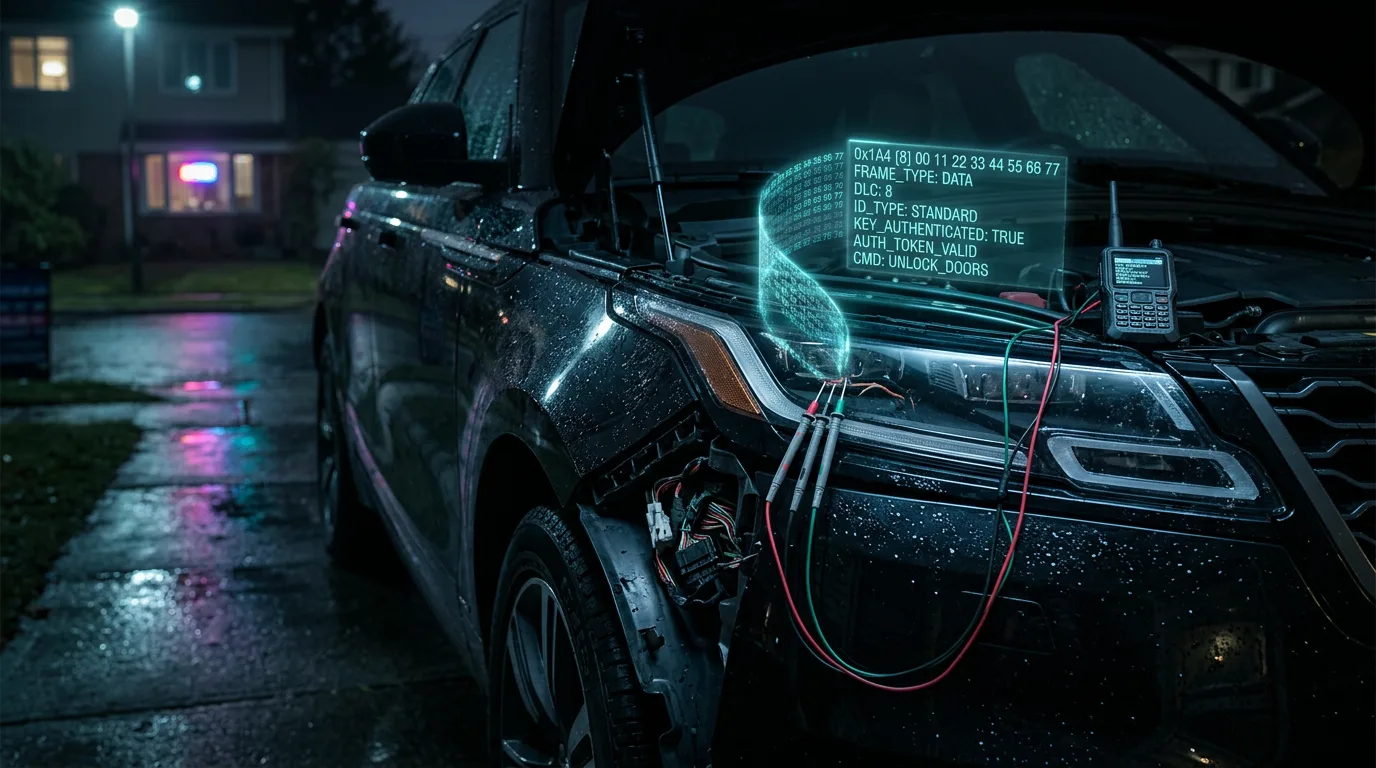
Modern car thieves no longer need your key, your radio signal, or your hallway. By peeling back the plastic lining of your front wheel arch, they access your front headlight connector, inject spoofed digital commands directly into the vehicle's internal nervous system, and drive away in under 90 seconds.
This attack, known globally as CAN Injection (or Headlight Hacking), renders Faraday pouches, steering wheel locks, and passive CCTV completely obsolete. Here is the hardware engineering behind the exploit, why street parking geography dictates risk, and how homeowners must calibrate their perimeter defense.
1. The Architectural Flaw: The Controller Area Network (CAN Bus)
To understand how a headlight can steal an entire vehicle, one must understand how modern cars are wired.
In an automobile manufactured after 2005, individual physical components—the engine throttle, automatic transmission, electronic door locks, radar cruise control, and adaptive LED headlamps—are not connected to the battery via separate, direct electrical cables. Instead, they form a distributed computer network known as the Controller Area Network (CAN Bus).
The 1986 Trust Architecture
The CAN bus standard was designed by Robert Bosch GmbH in the mid-1980s for factory automation and vehicle weight reduction: * Rather than running hundreds of pounds of copper wire through a chassis, all Electronic Control Units (ECUs) communicate across a single, shared twisted pair of wires: CAN-High and CAN-Low. * Every ECU on the bus broadcasts and receives messages using simple arbitration identifiers (e.g., CAN ID: 0x1E0). * The Fatal Flaw: The original CAN bus protocol possesses zero built-in cryptographic authentication or sender verification. Every node on the bus inherently trusts that every message broadcast on the network is legitimate.
2. Anatomy of the Attack: The Fake Bluetooth Speaker
In a modern luxury vehicle, the front adaptive headlights are not dumb light bulbs. They are intelligent microcomputers equipped with internal motor controls, beam-shaping actuators, and high-speed CAN transceivers that communicate with the central Body Control Module (BCM) and the Smart Key ECU.
Because the headlights sit on the vehicle’s high-speed CAN network, the wires running to the headlight assembly are an exposed digital extension of the car's most sensitive internal nervous system.
Here is the step-by-step sequence of a real-world CAN Injection attack:
[ Thief on Driveway ]
       │
       ▼ (1. Peels back wheel arch liner — 15 seconds)
[ Unplugs Headlight Connector ]
       │
       ▼ (2. Plugs in $30 CAN Injector disguised as JBL Speaker)
[ Hardware Injects Spoofed CAN Frames: "KEY_AUTHENTICATED = TRUE" ]
       │
       ▼ (3. Overwhelms legitimate bus traffic via Dominant Zero bits)
[ Doors Automatically Unlock — 35 seconds ]
       │
       ▼ (4. Sends "IMMOBILIZER_DISARM = TRUE" + "START_ENGINE")
[ Engine Fires Up & Vehicle Drives Away — 75 seconds total ]
The "Hardware in a Speaker" Weapon
When Dr. Ken Tindell and Ian Tabor reverse-engineered the devices sold on the criminal dark web for $3,000 to $5,000, they made a shocking discovery. The sophisticated attack hardware was packaged inside the hollowed-out chassis of an everyday JBL portable Bluetooth speaker: * Inside sat a basic PIC / STM32 microcontroller, a CAN transceiver chip, and custom attack firmware. * The thief simply strips two inches of the front bumper trim, unplugs the left headlight harness, jams two metal testing pins from the fake speaker into the exposed CAN-High and CAN-Low terminals, and presses "Play". * The microchip floods the vehicle’s gateway controller with high-priority dominant messages, spoofing the cryptographic confirmation normally sent by the legitimate Smart Key ECU. * The car’s central computer believes the owner has walked up, pressed the door handle, and hit the start button. The electronic steering lock disengages, the ignition lights up, and the car drives away quietly into the night.
3. Why Traditional Defenses Fail Completely
The emergence of CAN Injection has created a profound disconnect between what homeowners believe protects their vehicle and what actually happens on the driveway:
| Traditional Defense | Intended Function | Reality Against CAN Injection |
|---|---|---|
| Faraday Pouches / RFID Blocking Tins | Blocks radio amplification of the key inside the house | 100% Ineffective. The key is not involved in the attack; zero radio frequency transmission takes place. |
| Traditional Steering Wheel Bars (Disklok / Stoplock) | Prevents steering rotation | Partially bypassed. Thieves cut the soft polyurethane steering wheel rim with a 10-second reciprocating saw blade, slip the bar off, and steer using the spoke. |
| Standard Passive Ring / Nest Doorbells | Records video of the driveway | Post-mortem only. Passive infrared cameras send an alert after the thief is already inside the car. Police response times in suburban UK/US areas average 20–45 minutes; the vehicle is stripped in an industrial unit within an hour. |
4. The Real Factor: Street Micro-Geography & Spatial Exposure
Because CAN injection requires 60 to 90 seconds of physical kneeling at the front corner of the vehicle, criminal foraging patterns are dictated entirely by the micro-geography of the property:
- Victorian Terrace On-Street Parking (Maximum Risk):
Vehicles parallel-parked along narrow residential streets place the front bumper mere inches from the public sidewalk. A thief wearing dark clothing can kneel against the curb under the pretext of tying a shoelace, extract the headlight harness, and start the vehicle with zero trespass onto private property. - Driveways with Zero Sightlines (CPTED Blindspots):
Long suburban driveways tucked behind dense, unlit perimeter hedges provide thieves with complete acoustic and visual isolation from the street, giving them unlimited time to defeat physical barriers. - The 3-Minute Contagion Window:
Like residential burglaries, vehicle theft operates on near-repeat contagion. Once a crew validates that a specific model (e.g., Lexus RX, Toyota RAV4, Land Rover Defender) is parked overnight on a specific street, they return within 7 to 14 days to harvest adjacent matching vehicles.
5. The Physical Property Defense: Breaking the Attack Vector
Until automotive manufacturers fully roll out cryptographically signed onboard communications (SecOC / ISO 21434) to peripheral lighting nodes, protecting high-value vehicles parked at home requires active environmental and physical countermeasures:
1. Active Boundary Radar & Proactive Lighting
Passive cameras only record evidence for your insurance claim. Property defense requires active 3D millimeter-wave radar mounted at the facade that distinguishes between a passing pedestrian and someone loitering within 1.5 meters of the vehicle’s front quarter-panels. * Instant automated floodlighting (1,500+ lumens) combined with an audible perimeter chirp ruins the 60-second window of concealment required to manipulate the wheel arch.
2. Heavy-Duty Wheel Clamps vs Steering Wheel Locks
A hardened steel wheel clamp (such as a Sold Secure Gold / Diamond automotive clamp) covers the wheel lug nuts and physically anchors the wheel to the asphalt. A thief equipped with a CAN injector cannot drive away regardless of whether the engine starts.
4. Verified Hardware Recommendations (UK & US Affiliate Links)
| Defense Layer | Product Name | UK Link | US Link | Key Advantage |
|---|---|---|---|---|
| Full Wheel Armor | Disklok Gold Edition | Buy on Amazon UK | Buy on Amazon US | Sold Secure Diamond; outer shell spins freely if rim is cut |
| Physical Barrier | Telescopic Driveway Bollard | Buy on Amazon UK | Buy on Amazon US | Immovable concrete post; blocks drive-off even with running engine |
| Wheel / Arch Defense | Nemesis Ultra Wheel Clamp | Buy on Amazon UK | Buy on Amazon US | 15-second install; covers wheel bolts next to the headlight arch |
| Active 3D Radar | Ring Spotlight Cam Pro | Buy on Amazon UK | Buy on Amazon US | 3D mmWave radar + 2000 lm floodlight + 110dB siren |
| Diagnostic Lockout | OBD-II Port Physical Lock | Buy on Amazon UK | Buy on Amazon US | Metal tamper-proof cap stops key-cloning fallback attacks |
3. Physical CAN-Bus Firewall Retrofits
Specialist vehicle security firms now install secondary aftermarket CAN firewalls (such as the Ghost-II or StarLine immobilizers). These devices sit between the engine ECU and the vehicle wiring, requiring a unique sequence of physical button presses on the steering wheel before the transmission will engage, completely neutralizing spoofed headlight packets.
The HabitatReport Diligence Framework
At HabitatReport, our property security models do not rely on generic postcode crime summaries. We evaluate the spatial vulnerability of the parking infrastructure: * On-street curbside vulnerability vs. secure gated setbacks. * Local vehicle theft incident frequency calibrated against keyless and CAN-bus exploitation trends (Police.uk and FBI UCR micro-data). * Recommendations for certified active deterrent hardware and physical boundary barriers.
When evaluating a new home, remember: your driveway is not just a parking spot—it is the outer perimeter of your household security.
Key Scientific References: * Tindell, K. (2023). "CAN Injection: How thieves steal vehicles via headlight wiring." Canis Automotive Labs Research Bulletin. * Tabor, I., & Tindell, K. (2023). "Reverse Engineering the Dark Web Headlight Injection Device." DEF CON 31 Car Hacking Village Proceedings. * Bosch, R. (1991). "CAN Specification Version 2.0." Robert Bosch GmbH. * HabitatReport Automotive & Perimeter Security Intelligence Engine (habitatreport.co)
Disclaimer: This article is independent editorial content. HabitatReport may earn a commission if you purchase through product links at no extra cost to you. Always check your local regulations and current product listings before purchase.