In 2014, mathematician Dr. Hannah Fry took the stage at the Royal Institution to pose a seemingly impossible question: Can mathematics predict the future? While her lecture touched on everything from relationship dynamics to Benford’s law, one case study immediately riveted property developers, criminologists, and homeowners alike: the predictive mathematics of residential burglaries.
Drawing on pioneering research conducted by applied mathematicians at UCLA (led by Dr. Andrea Bertozzi and anthropologist Dr. Jeffrey Brantingham) alongside police departments in Southern California, researchers discovered that break-ins are not random acts of opportunistic chaos. In reality, they obey the exact same mathematical laws that govern seismological aftershocks along tectonic fault lines.
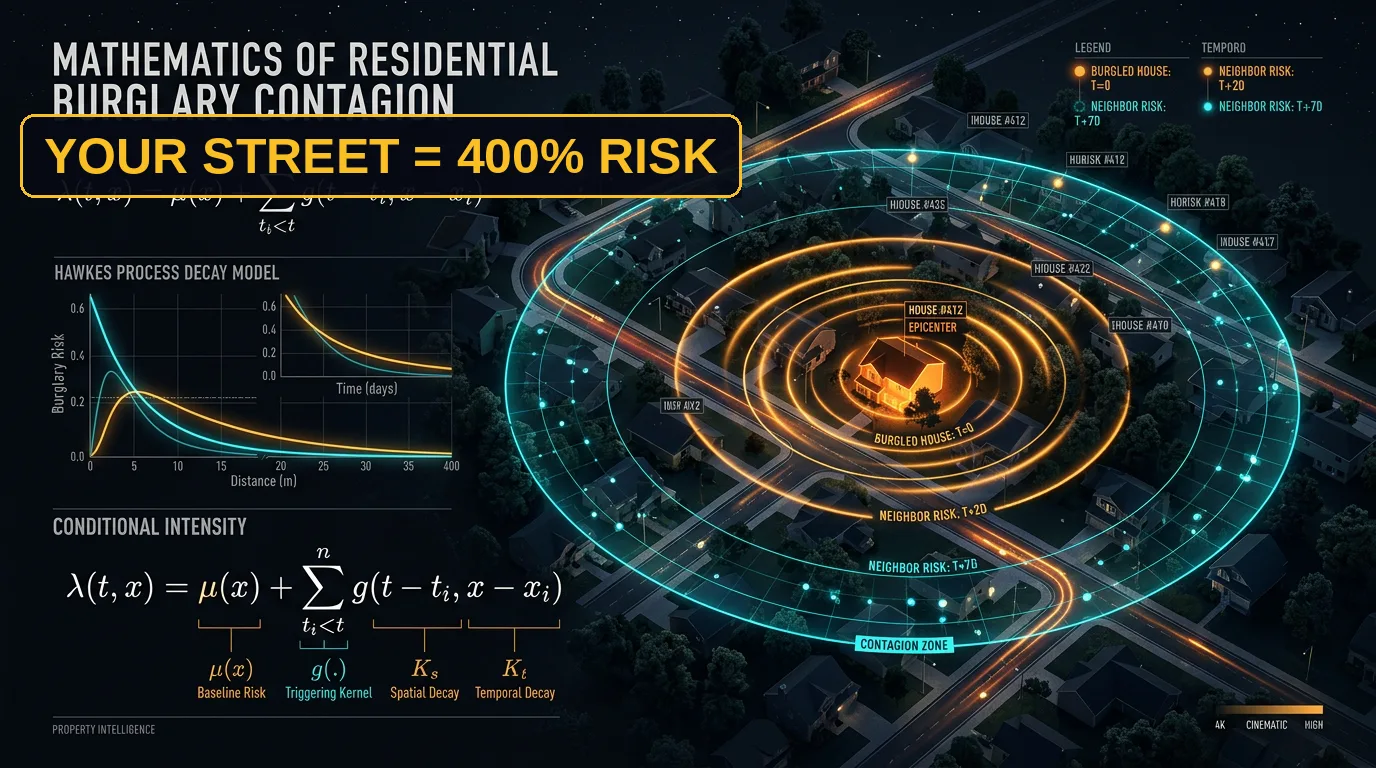
1. The Seismology of a Break-In: The Hawkes Point Process
When an earthquake ruptures along an underground fault, it releases tremendous shear stress, temporarily destabilizing adjacent geological fractures. Seismologists model the timing and magnitude of secondary aftershocks using what is known as self-exciting point processes (Hawkes processes) and the Omori-Utsu law.
In applied spatial criminology, a residential burglary acts as the primary geological tremor:
Where:
- μ(x) represents the static baseline background crime risk of the neighborhood.
- g(t - ti, x - xi) is the self-excitation triggering kernel—a mathematical spike in probability that decays exponentially across both spatial distance (meters) and temporal latency (days).
Why does a human criminal act like a tectonic plate?
The answer lies in two well-documented behavioral and architectural principles:
- Optimal Foraging Theory: Like a predatory animal that discovers a fertile hunting ground, a burglar who successfully enters a home has resolved all major operational uncertainties: they know the street’s pedestrian rhythm, parking blind spots, local police dispatch latency, and dog patrol habits.
- Architectural Homogeneity: Homes built in the same subdivision or Victorian terrace share identical build years, layout orientations, and mechanical vulnerabilities. If a burglar successfully pops a flimsy 1970s euro-cylinder or a sliding patio latch on House #12, they know with 95% certainty that Houses #14, #16, and #18 share that exact same point of entry.
Empirical crime telemetry confirms that for properties located within 200 to 400 meters of a recent break-in, the risk of burglary elevates by up to 400% immediately following the event, before decaying back to the municipal baseline over a tight window of 14 to 28 days.
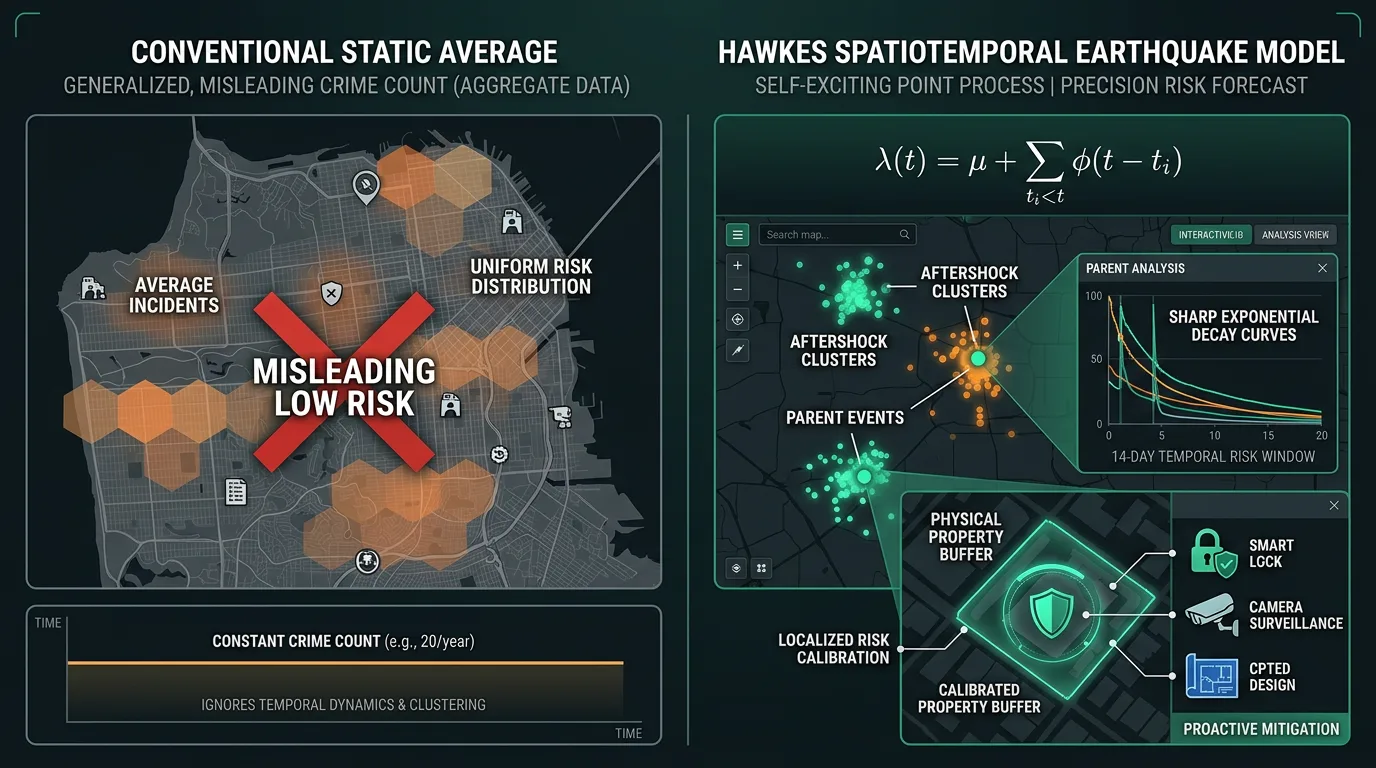
2. Why Real Estate Portals (Zillow, Redfin, Rightmove) Deceive Buyers
When prospective buyers browse homes on mainstream property portals, they are typically presented with a flat, aggregated label: "Crime Rating: Low — 18 Incidents in the Last Year."
From a mathematical standpoint, this is as misleading as assessing earthquake risk by averaging tremor counts across a decade without knowing whether you are standing on an active rupture right now.
- Averages flatten reality: Eighteen burglaries distributed evenly over 365 days across an entire postal sector represent a low-level, predictable background risk (μ).
- Clusters reveal active danger: Eighteen burglaries concentrated into three rapid, two-week bursts represent serial near-repeat contagion—a dedicated crew actively harvesting a specific cluster of identical homes.
3. How Physical Property Buffers Break the Equation
The crucial breakthrough emphasized by Hannah Fry’s analysis is that while aggregate human behavior follows mathematical distributions, individual properties are not helpless statistics. Homeowners can actively insert physical damping coefficients into the equation:
1. Hardware Modernization (Neutralizing the Architectural Weakness)
If an entire street was built in 1985 with vulnerable UPVC door mechanisms, upgrading your own locks to 3-star Sold Secure Diamond / TS007 anti-snap cylinders immediately breaks the burglar’s predictable advantage. The predator tests the cylinder, realizes the easy exploit is blocked, and moves down the contagion vector.
2. Natural Surveillance & CPTED Principles
Crime Prevention Through Environmental Design (CPTED) focuses on line-of-sight. Properties set back behind overgrown, 7-foot privacy hedges provide the 90 seconds of total visual privacy needed to pry open a ground-floor sash window. Trimming sightlines eliminates the opportunistic blind spot.
3. 3D Radar Perimeter Detection
Traditional passive infrared (PIR) cameras trigger false alarms on windblown branches, causing homeowner alarm fatigue. Modern millimeter-wave radar and AI vision identify human silhouettes at the property boundary line, triggering proactive lighting before mechanical contact is attempted.
This is why HabitatReport uses a Dual-Score System. We display the Macro Baseline (the statutory district statistics from police and municipal records) alongside the Calibrated Property Score—because a home with modern anti-snap glazing, perimeter sensors, and verified hardware should never be penalized for an unmitigated street average.
Summary: Calibrate for Reality, Not Static Averages
Whether examining toxic PFAS contaminants in the municipal aquifer, microscopic diesel PM2.5 particulate drift from an adjacent motorway, or the mathematical aftershocks of neighborhood crime, the lesson of modern data science is clear:
Statutory averages describe the region. Only physical diligence describes your home.
4. Recommended Security Hardware to Break the Contagion Cycle
After reviewing thousands of property risk profiles across the UK and US, the HabitatReport engineering team identified three high-performance solutions specifically engineered to disrupt the Hawkes Point Process and physically break the near-repeat contagion vector. Each of these hardware upgrades directly impacts your property's Calibrated Security Score.
- 3D radar motion detection — precisely distinguishes humans from windblown foliage
- 110dB remotely triggered siren — instantly breaks the thief's 60-second window of concealment
- Dual LED floodlights — illuminates full driveway perimeter
- 1536p HDR video with night vision and two-way audio
As a HabitatReport reader, you support independent research by using these referral links at no extra cost to you.
- 4K UHD forensic video — facial recognition capture up to 9 meters
- Built-in 16GB encrypted local storage — no mandatory subscription
- AI subject tracking — cross-camera handoff when a thief moves between zones
- Solar panel self-charging (install-and-forget)
As a HabitatReport reader, you support independent research by using these referral links at no extra cost to you.
- Blocks 10Hz–6GHz radio frequencies — prevents relay attack amplification from inside the house
- Dual-layer Faraday shielding — protects up to 5 key fobs simultaneously
- Cheap insurance — under £20 / $25 for total key isolation while at home
- Note: Defends against classic relay attacks (though not CAN injection—pair with the cameras above for full coverage)
As a HabitatReport reader, you support independent research by using these referral links at no extra cost to you.
Check Your Property's Calibrated Risk Profile
Run a free instant address scan to view local water filtration parameters, micro-air particulate drift, property age vulnerabilities, and neighborhood baselines.