The Galvanic Plumbing Trap: Why Modern Copper Renovations Can Accelerate Tap Water Lead Leaching by 1,000% in Pre-1986 Homes
A partial pipe replacement can spike lead leaching by 1,000% in pre-1986 homes. The galvanic couple nobody surveys for — and how to break the circuit.
In this article
- 1. The Electrochemistry of a Plumbing Battery: The Galvanic Couple
- 2. The Partial Replacement Catastrophe: The Surface Area Ratio Trap
- 3. The Water Chemistry Catalyst: Why Chloramines Make It Worse
- 4. Why Traditional Home Surveys and Real Estate Agents Miss It
- 5. The Solution: How to Break the Galvanic Circuit
- The HabitatReport Diligence Principle
Galvanic Corrosion in Your Plumbing
Mixed metals create a battery inside your walls — dissolved metals heading straight for your glass.
When browsing a newly refurbished Victorian, Edwardian, or mid-century home in the UK or United States, prospective buyers are routinely greeted with an alluring selling point:
"Complete interior renovation — all internal plumbing upgraded with brand-new, premium copper piping."
On the surface, this sounds like the gold standard of responsible property maintenance. The toxic lead pipes that once ran through the basement and behind the plasterboards have been surgically stripped out and replaced with gleaming, sterile metal. The survey report gives the interior plumbing a clean bill of health.
However, electrochemists, materials scientists, and environmental engineers led by Professor Marc Edwards (the MacArthur Fellow and Virginia Tech engineer whose forensic water analysis uncovered the Washington D.C. and Flint, Michigan lead crises) have exposed a terrifying unintended consequence:
When modern copper pipes are connected directly to an aging municipal lead service line at the property boundary, you do not eliminate lead contamination—you construct a high-voltage galvanic battery beneath your front yard that accelerates toxic lead leaching into your drinking water by up to 1,000%.
This phenomenon, known in civil engineering as the Partial Lead Service Line Replacement (PLSLR) Disaster, represents one of the most hazardous blind spots in residential real estate. Here is the electrochemistry behind the trap, why standard home surveys miss it, and how property buyers must verify their water safety.
1. The Electrochemistry of a Plumbing Battery: The Galvanic Couple
To understand why new copper can poison an old home, one must examine the fundamental laws of electrochemistry: specifically, the Galvanic Series of Standard Reduction Potentials ($E^\circ$).
When two dissimilar metals with different electrical potentials are physically connected while submerged in a conductive electrolyte (such as municipal tap water containing dissolved mineral salts, chloramines, and sulfates), an electrochemical galvanic cell is spontaneously formed:
| Metal | Role in the Cell | Standard Reduction Potential ($E^\circ$) | Behavior |
|---|---|---|---|
| Copper ($Cu$) | Cathode (Noble Metal) | $+0.34\text{ V}$ | Protected from corrosion; receives electrons |
| Lead ($Pb$) | Anode (Sacrificial Metal) | $-0.13\text{ V}$ | Rapidly oxidizes & corrodes; donates electrons |
The resulting galvanic potential difference between copper and lead is approximately $+0.47\text{ Volts}$:
$$\Delta E = E^\circ_{\text{cathode}} - E^\circ_{\text{anode}} = (+0.34\text{ V}) - (-0.13\text{ V}) = +0.47\text{ V}$$
In electrical engineering, half a volt is more than enough to drive sustained electrochemical work. In plumbing, that half-volt turns the remaining lead pipe into a sacrificial anode:
$$\text{Anodic Reaction (Corrosion): } Pb_{(s)} \longrightarrow Pb^{2+}_{(aq)} + 2e^-$$
The copper pipe acts as an electron sponge, continuously pulling valence electrons from the lead. To maintain electrical neutrality, the lead atoms shed their electrons and dissolve directly into the standing water as microscopic, highly neurotoxic lead ions ($Pb^{2+}$).
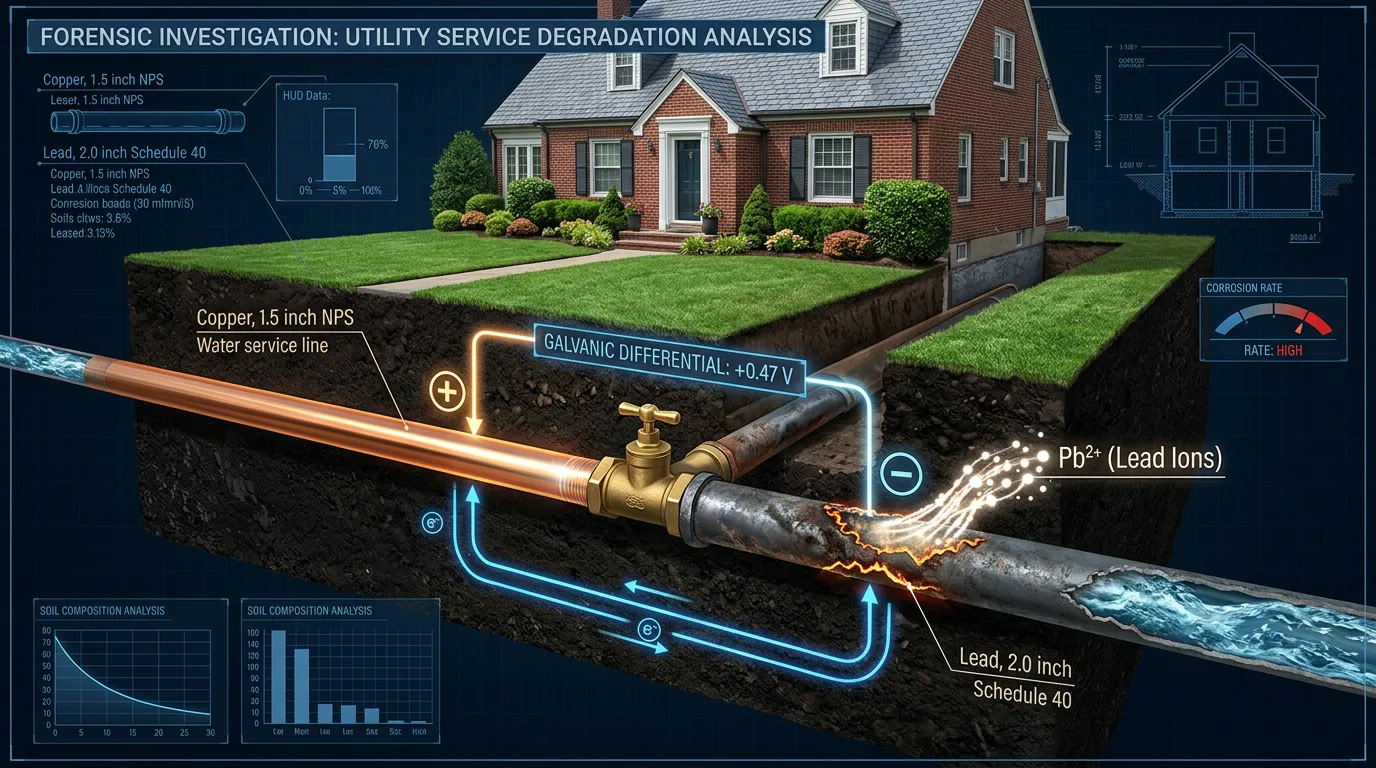
2. The Partial Replacement Catastrophe: The Surface Area Ratio Trap
Before an interior renovation, an older property might have had lead piping throughout the house, connected to a lead service line running under the street.
While unquestionably unhealthy, an old lead system eventually forms a fragile, passivated mineral crust (a protective patina of lead carbonates and phosphates, known as plumbonacrite or cerussite) over 50 to 80 years. This crust partially shields the raw metal from the flowing water, keeping leaching rates relatively stable.
When a homeowner performs a partial replacement—replacing the internal private pipes with copper while leaving the municipal utility pipe (from the water main to the boundary stopcock) as lead—two catastrophic things occur simultaneously:
1. The Disruption of the Passivation Crust
The mechanical vibrations of sawing, wrenching, and soldering at the property boundary crack the brittle 60-year-old mineral crust lining the municipal lead pipe. Massive particulate lead flakes (often measuring in thousands of parts per billion) are instantly released into the line.
2. The Unfavorable Cathode-to-Anode Area Ratio
In electrochemistry, corrosion rates are dictated by the ratio of the cathode surface area to the anode surface area:
$$\text{Corrosion Rate} \propto \frac{\text{Surface Area of Cathode (Copper)}}{\text{Surface Area of Anode (Lead)}}$$
When you install 50 meters of new copper pipe inside a house (a massive cathode) connected to just 5 meters of municipal lead pipe at the street (a small anode), the galvanic current density focusing on the remaining lead increases exponentially.
Peer-reviewed studies published by Professor Marc Edwards and the American Water Works Association (AWWA) demonstrated that lead concentrations in first-draw tap water frequently spike from baseline levels of 5–10 ppb to over 100–1,000 ppb immediately following a partial copper replacement—far exceeding the EPA action level of 15 ppb and the World Health Organization guideline of 10 ppb.
3. The Water Chemistry Catalyst: Why Chloramines Make It Worse
The severity of galvanic lead leaching is not uniform across all postcodes; it depends heavily on the chemical disinfectant recipe used by the municipal water treatment authority:
- Free Chlorine Disinfection: Favors the formation of insoluble lead dioxide ($PbO_2$), which can provide partial passivation if water pH is maintained above 8.0.
- Chloramines (Monochloramine): Many modern utilities (including London water authorities and major US metropolitan providers) transitioned from chlorine to chloramines to reduce cancer-causing disinfection byproducts (THMs). However, chloramines do not form insoluble $PbO_2$ scales. Instead, they promote a lower oxidation-reduction potential that destabilizes lead scales, supercharging the galvanic galvanic corrosion rate when copper is introduced.
4. Why Traditional Home Surveys and Real Estate Agents Miss It
When a chartered surveyor or home inspector evaluates a property: 1. They look under the kitchen sink and inside the boiler cupboard. 2. They see modern copper or plastic speed-fit connections. 3. They mark the plumbing report: "Visual inspection confirms modernized copper distribution. No internal lead pipework observed."
The surveyor cannot see through three feet of paved driveway or asphalt road where the private copper pipe joins the municipal authority’s Victorian lead goose-neck. Unless an explicit street-boundary acoustic or excavation check is performed, the buyer inherits an invisible toxic battery.
5. The Solution: How to Break the Galvanic Circuit
Eliminating the galvanic plumbing trap requires strict mechanical and filtration protocol:
A. The Dielectric Barrier (Electrical Isolation)
If a municipal lead line cannot be replaced immediately by the water utility, modern plumbing standards require the insertion of a Dielectric Union or a minimum of 2 to 3 meters of non-conductive PEX / polyethylene piping between the lead line and the interior copper manifold. This breaks the electrical continuity, halting the transfer of electrons and killing the galvanic battery.
B. Full-Line Coordinated Replacement
The private property owner and the municipal water provider must coordinate to replace the entire pipe from the water main in the middle of the street all the way to the water meter with food-grade high-density polyethylene (HDPE).
C. Certified Point-of-Use Extraction (NSF/ANSI 53 & 58)
Even after galvanic isolation, legacy particulate lead embedded in fixture valves can shed for up to 12 months. Standard pitcher filters (carbon-only) are completely incapable of removing ionic lead or sub-micron particulate lead. Only point-of-use systems certified specifically for NSF/ANSI 53 (Heavy Metal Reduction via ion-exchange resin) or NSF/ANSI 58 (Reverse Osmosis) can reliably reduce dissolved and particulate lead to non-detectable levels below health advisory limits.
The HabitatReport Diligence Principle
At HabitatReport, our water security algorithms do not simply ask whether a home looks modern inside. We cross-reference the construction vintage of the neighborhood (pre-1986 lead ban) with historical municipal service line records and water utility disinfectant chemistry.
When buying a home, aesthetics can be deceiving: a freshly soldered copper pipe without a verified dielectric buffer is not an upgrade—it is an active electrochemical hazard.
Key Scientific References: * Edwards, M., & Dudi, A. (2004). "Role of chlorine and chloramines in galvanic corrosion of lead." Journal of the American Water Works Association (AWWA), 96(10), 69-81. * Cartier, C., Arnold, R. B., et al. (2012). "Effect of partial lead service line replacement on lead levels in drinking water." Water Research, 46(14), 4409-4416. * St. Clair, J., & Edwards, M. (2016). "Galvanic corrosion of lead in drinking water: Mechanisms and mitigation strategies." Environmental Science & Technology. * HabitatReport Water Quality & Pipe Vintage Diagnostic Engine (habitatreport.co)
Disclaimer: This article is independent editorial content. HabitatReport may earn a commission if you purchase through product links at no extra cost to you. Always check your local regulations and current product listings before purchase.