The Hot Shower Inhalation Paradox: Why Your Lungs Absorb More Water Contaminants in a 15-Minute Shower Than Drinking 2 Liters of Tap Water
Your lungs absorb more PFAS and VOCs in a hot shower than from two litres of drinking water. Here is the physics — and why pitcher filters only protect 1% of household water.
In this article
The Hot Shower Inhalation Problem
Steam opens your airways and volatilises dissolved contaminants — everything in the water goes straight into your lungs.
In millions of health-conscious households across the UK and United States, a familiar ritual plays out daily: * Pouring tap water into a certified pitcher filter or countertop jug before taking a sip. * Installing a sleek reverse-osmosis tap next to the kitchen sink for cooking and infant formula. * Buying bottled mineral water under the assumption that ingestible water is the sole vector of chemical contamination.
Families take comfort in the belief that by filtering the two liters of water they drink each day, they have successfully shielded their bodies from municipal tap water contaminants—including industrial PFAS "forever chemicals", carcinogenic disinfection byproducts like chloroform (trihalomethanes / THMs), and chlorinated volatile organic compounds (VOCs).
However, landmark environmental health research conducted by researchers at the American Journal of Public Health (AJPH), the EPA's Total Exposure Assessment Methodology (TEAM) team led by Dr. Lance Wallace, and environmental toxicology studies led by Dr. Halina Brown at Clark University have uncovered a startling medical and physical reality:
Exposure research (Brown et al., 1984; Wallace, 1997) shows the internal dose of volatile chemicals absorbed during a single hot shower is comparable to — and for some compounds greater than — the dose from drinking two litres of the same unboiled tap water.
By treating only the 1% of water that enters the kitchen glass, households leave the primary exposure pathway wide open. Here is the physical chemistry behind the Hot Shower Inhalation Paradox, why your lungs act as an unfiltered chemical superhighway, and how property diligence requires whole-home protection.
1. The Physics of the Shower: The Atomization Chamber
To understand why a shower is radically more dangerous than a drinking glass, one must examine the physical mechanics of a modern showerhead:
A. Mechanical Atomization & Surface Area Explosion
When municipal water passes through a pressurized showerhead at 9 to 11.5 litres (2 to 2.5 gallons) per minute, the stream is mechanically sheared into millions of micro-droplets ranging from 100 to 500 microns in diameter. * In a glass of water, only the top flat surface (a few square inches) interacts with the ambient air. * In a shower spray, the collective surface area of millions of suspended droplets increases the water-to-air interface by a factor of over 10,000x, transforming the shower stall into a high-efficiency stripping column.
B. Thermal Stripping & Henry's Law
Municipal water utilities use chemical disinfectants (free chlorine or chloramines) to kill bacteria in the pipes. These disinfectants react with natural organic matter to form trihalomethanes (THMs), of which chloroform ($CHCl_3$) is the primary constituent.
According to Henry's Law, the solubility of a volatile compound in water is inversely related to temperature:
$$K_H(T) = K_H^\circ \exp\left( -C \left(\frac{1}{T} - \frac{1}{T^\circ}\right) \right)$$
When tap water is heated to a comfortable shower temperature of 40°C to 43°C (104°F to 110°F), Henry’s constant drops sharply. Dissolved volatile chemicals lose their affinity for the liquid phase and spontaneously vaporize into a gas: * Up to 50% to 80% of dissolved chloroform is stripped out of the water droplets and released into the air within 60 seconds of turning on the hot tap. * Short-chain industrial fluorinated surfactants (ultra-short PFAS / PFCAs) and volatile solvent residues (such as trichloroethylene - TCE) flash-vaporize alongside water vapor.
C. Confined Space Concentration
The average residential bathroom has an enclosed volume of only 15 to 25 cubic meters. With the bathroom door and windows closed, the concentration of airborne chloroform and volatile contaminants rises exponentially, turning the shower stall into a concentrated inhalation gas chamber.
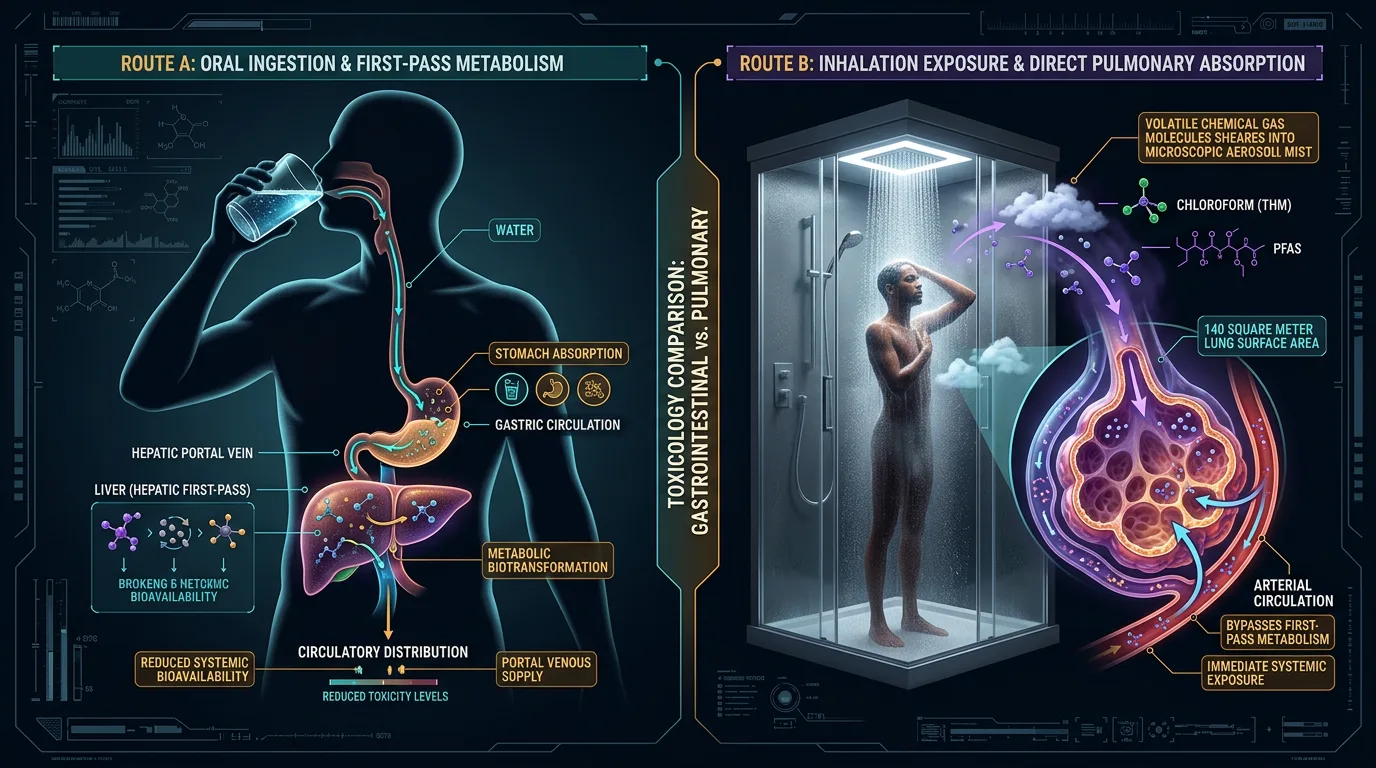
2. The Biological Superhighway: Alveolar Lungs vs. The Liver
Why is inhaling a chemical infinitely more damaging than drinking it? The answer lies in human comparative anatomy:
[ Ingesting Water (Drinking Glass) ]
                 │
                 ▼
     [ Gastrointestinal Tract ]
  (Acid breakdown & Mucus Barrier)
                 │
                 ▼
       [ Hepatic Portal Vein ]
                 │
                 ▼
       [ Liver First-Pass ]  ──► (Enzymatic detoxification & filtration)
                 │
                 ▼
        [ Systemic Blood ]

-------------------------------------------------------------------------

[ Inhaling Shower Steam (15-Minute Shower) ]
                 │
                 ▼
       [ 300 Million Alveoli ]  ──► (Ultra-thin 0.5-micron epithelial barrier;
                 │                    Surface area: 100–140 m² — size of a tennis court)
                 ▼
  [ Instant 100% Direct Transfer ]
                 │
                 ▼
  [ Systemic Arterial Circulation ]  (ZERO liver filtration; toxins reach brain,
                                      heart, and kidneys in under 8 seconds)
The Missing Liver Filter
When you swallow water containing contaminants, it passes through your stomach and intestines and is routed through the hepatic portal system directly to your liver. The liver’s cytochrome P450 enzyme system actively metabolizes and neutralizes a significant portion of toxins before they reach your brain, heart, or peripheral organs.
When you breathe aerosolized water vapor into your lungs: 1. The vapor contacts your pulmonary alveoli, which feature a blood-gas barrier only 0.5 microns thick—designed specifically for instantaneous gas exchange. 2. The total alveolar surface area of human adult lungs spans between 100 and 140 square meters (roughly the size of a tennis court). 3. Volatile chloroform and fluorinated compounds diffuse across this membrane almost instantaneously, dumping 100% of their chemical payload directly into oxygenated arterial blood, completely bypassing liver detoxification.
The landmark clinical study published in the American Journal of Public Health (Brown, Bishop, & Rowan) proved that an individual receives an internal dose of volatile chemicals during a 15-minute shower comparable to or greater than drinking two liters of unboiled municipal tap water from the same source.
3. The Pitcher Filter Trap: Protecting 1% of Household Water
The popularity of pitcher filters (such as standard Brita or Pur jugs) has created a dangerous false sense of security among prospective homeowners.
Consider typical household water utilization: * Water consumed via drinking/cooking: Approximately 3 to 5 liters per person per day (~1% to 2% of total household water). * Water utilized for showering, bathing, teeth-brushing, and handwashing: Approximately 150 to 250 liters per person per day (~98% of total household water).
When a homeowner relies exclusively on a kitchen pitcher filter: * They are applying filtration to less than 2% of the water molecules entering their home. * They leave their family exposed to daily respiratory and dermal absorption of municipal chemicals during hot showers, infant bath time, and high-temperature dishwasher venting.
Furthermore, basic pitcher filters rely on simple granular activated carbon (GAC), which rapidly channels and saturates within 20 to 30 days, losing the ability to sequester short-chain PFAS or heavy metals.
4. The Solution: Whole-House Diligence & Point-of-Entry Filtration
True environmental diligence requires treating municipal water before it enters the domestic heating and aerosolization system:
A. Point-of-Entry (POE) Whole-House Filtration
A comprehensive whole-house system installed at the main utility stopcock (before the water enters the hot water cylinder or combi-boiler): * Stage 1 (Sub-Micron Sediment Filter): Removes rust, microplastics, and particulate matter shed from aging municipal pipes. * Stage 2 (Catalytic Carbon Block): Catalytic carbon features an engineered pore structure that catalytically fractures chloramines and adsorbs volatile trihalomethanes (chloroform) and long-chain PFAS before water is heated. * Stage 3 (KDF-55 Media): High-purity copper-zinc granules that use redox chemistry to convert dissolved free chlorine into harmless, non-volatile chloride ions, preventing gas release in showers.
B. Dedicated KDF-85 / Carbon Shower Heads (The Renter's Solution)
For tenants and flat owners who cannot install whole-house plumbing alterations, installing certified multi-stage shower filtration containing KDF-55 redox media and calcium sulfite neutralizes chlorine and volatile gas release at the shower wand.
C. Continuous Negative Pressure Bathroom Ventilation
To prevent aerosolized volatile gases from migrating into adjoining bedrooms, bathrooms should maintain continuous mechanical extraction (minimum 50 CFM intermittent, or 20 CFM continuous) that exhausts directly to the exterior building envelope.
The HabitatReport Diligence Principle
At HabitatReport, our water security algorithms do not separate drinking water from bathing water. We calculate your home's total environmental burden based on: * Regional water utility disinfection chemistry (Chloramine vs. Free Chlorine ratios). * Documented trihalomethane (THM) and PFAS concentrations in the municipal aquifer. * Verification of whether a property features a Whole-House Point-of-Entry (POE) barrier or relies solely on vulnerable kitchen-point filters.
When evaluating a future home, remember: you don't just drink your water—you breathe it into your bloodstream every single morning.
Key Scientific References: * Brown, H. S., Bishop, V. M., & Rowan, C. A. (1984). "The role of skin absorption as an angle of exposure for volatile organic compounds (VOCs) in drinking water." American Journal of Public Health (AJPH), 74(5), 479-484. * Wallace, L. A. (1997). "Human exposure and body burden for chloroform and other trihalomethanes." Critical Reviews in Environmental Science and Technology, 27(2), 113-194. * Weisel, C. P., & Jo, W. K. (1996). "Ingestion, inhalation, and dermal exposure to chloroform in tap water." Environmental Health Perspectives, 104(1), 48-51. * HabitatReport Water Quality & Aerosolization Risk Engine (habitatreport.co)
📑 Your shower is your biggest water exposure. What's in yours?
Run a free property health scan to see your address's water chemistry — disinfectant type, THMs, PFAS — and whether a point-of-entry barrier makes sense for your home.
🔍 Scan your property free → 🧩 Get the Chrome Extension →Disclaimer: This article is independent editorial content. HabitatReport may earn a commission if you purchase through product links at no extra cost to you. Always check your local regulations and current product listings before purchase.