The Airtightness Paradox: Why Modern Eco-Renovations Can Double Indoor Radon — and Why No Survey Tests for It
Radon-222 is the second-leading cause of lung cancer in the UK and the number one cause among non-smokers in the US — and the homes being sealed tighter for energy efficiency are exactly the homes where it concentrates. No RICS Level 1/2 survey and no standard US home inspection measures it. A £30 detector settles the question.
🛰️ Is your address in a radon-affected area?
Run a free 1-page scan: build-era context, regional radon potential, and the checks no survey covers.
🔍 Scan your UK address free →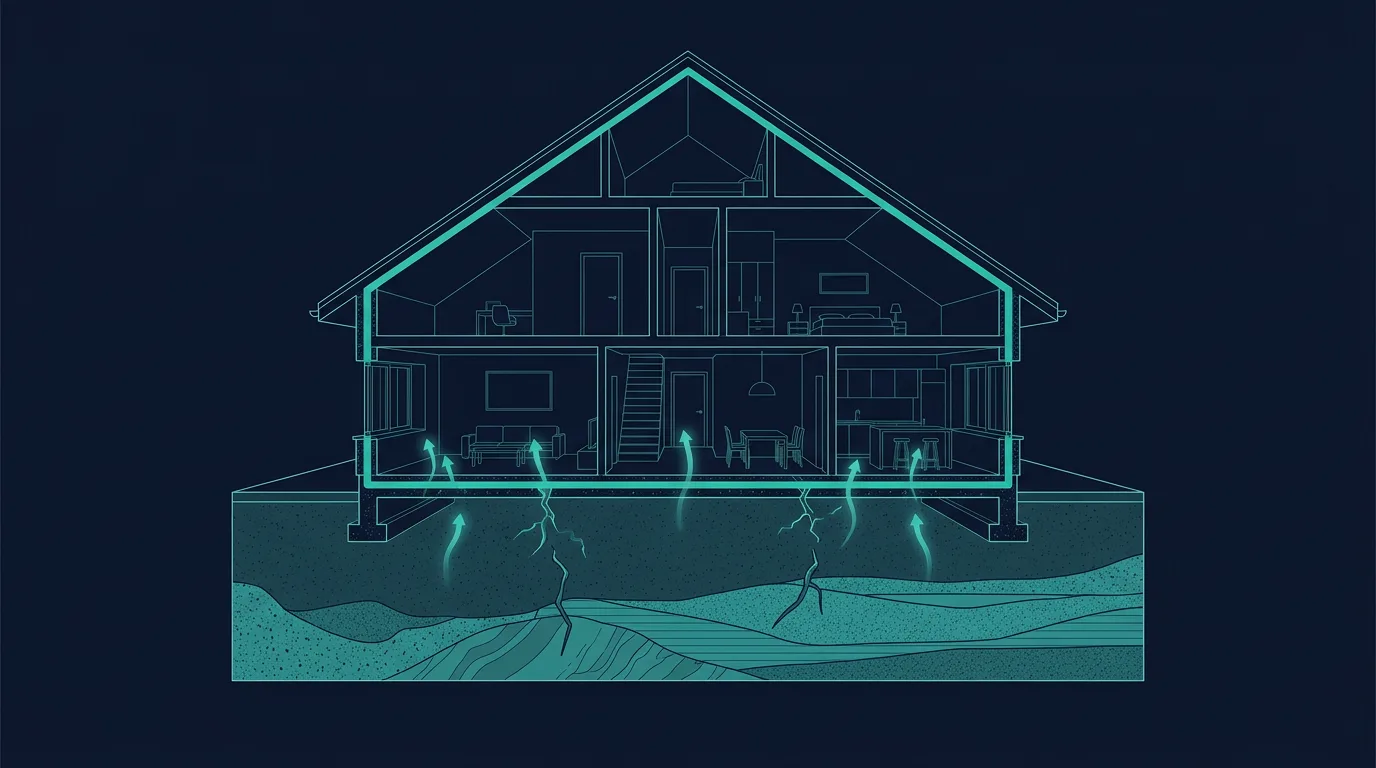
In this article
- 1. The Contaminant Your Survey Was Never Designed to Find
- 2. The Physics: Uranium, Radium-226 and the 3.8-Day Daughter Problem
- 3. The Airtightness Paradox: Sealing Kills Dilution
- 4. The Geography: Cornwall's 1-in-3 and America's Zone 1
- 5. The Units Game: Why the UK's Action Level Is Stricter Than America's
- 6. Testing: The £30 Detector That Beats the £800 Survey
- 7. Mitigation: Sub-Slab Depressurization and the Renegotiation Play
1. The Contaminant Your Survey Was Never Designed to Find
A standard UK RICS HomeBuyer Report and the standard US home inspection share a structural blind spot: both are visual inspections. They look at what can be seen — roofs, damp, wiring, foundations. Radon-222 is an odourless, colourless, chemically inert noble gas. It leaves no visual signature, no staining, no bloom. It is detectable only by integrating the average concentration over weeks, which is precisely what no inspection-and-survey workflow allows for.
The consequence is asymmetric risk: the buyer assumes the survey covered everything hazardous in the home, while the hazard with the highest attributable cancer burden in the UK after smoking — an estimated 1,100 lung cancer deaths per year (UKHSA) — sits below the floor slab, untested. In the US, the EPA attributes roughly 21,000 lung cancer deaths per year to residential radon, of which about 2,900 occur in people who never smoked.
This is not an argument that surveys are negligent. Radon is probabilistic (geology-dependent), invisible, and cheap to test independently — so the market quietly assigns it to nobody. The buyer who understands this owns the gap.
2. The Physics: Uranium, Radium-226 and the 3.8-Day Daughter Problem
Radon is not an exotic contaminant. Trace uranium occurs in granite, black shale, and phosphate-rich soils everywhere. Uranium-238 decays through a long chain to radium-226, which decays in turn to radon-222 — a gas with a half-life of 3.8 days. Being a gas, it migrates: it diffuses through soil pores and is drawn upward by pressure differentials between the warm, depressurized interior of a house and the cooler sub-slab soil. The building's own thermal behavior is the pump.
Once inhaled, radon itself is largely exhaled. The problem is its short-lived progeny — polonium-218 and polonium-214 — which are solids. They plate out on lung epithelium and decay there, delivering localized alpha-particle dose. Alpha particles do most of their damage within a very short range: the biological effect concentrates where the particle lands. This is why radon exposure is quantified in cumulative dose over years, not incidents — a home at 400 Bq/m³ is not "twice as bad as one incident"; it is a chronic exposure rate.
3. The Airtightness Paradox: Sealing Kills Dilution
Here is the paradox that ties this guide to the energy-transition era. Indoor radon concentration is governed by a simple mass balance: radon inflow from the ground divided by dilution (ventilation) and decay. Decay is fixed by physics; inflow depends on geology and pressure differentials. Dilution is the only lever the building envelope controls — and modern retrofit work deliberately reduces it.
Passivhaus-grade refurbishments, replacement sealed glazing, blocked trickle vents, cavity-wall insulation, and draught-proofing all cut air changes per hour (ACH). A Victorian home can sit at 2–4 ACH naturally; a tightened post-retrofit home can drop below 0.6 ACH under the same Passive House standard that wins awards. Cut dilution by two-thirds with constant inflow, and steady-state radon concentration scales upward roughly proportionally. Field measurements consistently show elevated radon in retrofitted homes compared to their pre-retrofit baselines.
This is why the two most energy-efficient, most insulated, most commendable homes on any street can be the most radioactive ones. It is also why radon risk clusters in exactly the places buyers associate with quality: new-build estates, deep retrofits, and solid-wall renovations. Energy efficiency and radiation hygiene are not enemies — but they must be reconciled with mechanical ventilation (MVHR) rather than left to chance.
4. The Geography: Cornwall's 1-in-3 and America's Zone 1
Radon risk is geological, not architectural. The UKHSA maintains a national map of Radon Affected Areas — defined as areas with at least a 1% probability of a home exceeding the Action Level — built from over 560,000 indoor measurements combined with British Geological Survey data. Roughly 5% of UK homes exceed the 200 Bq/m³ action level nationally. In Cornwall, parts of Devon, the Peak District, Northamptonshire and Somerset, the exceedance rate climbs to over 30% in some 1 km grid squares.
In the US, the EPA's Radon Zones map (based on geology and indoor measurements) assigns much of the Upper Midwest, Appalachia, and the Rocky Mountain belt to Zone 1 — the highest predicted-risk designation. The national statistic is blunt: about 1 in 15 US homes measures at or above the EPA action level of 4 pCi/L. At that concentration, the EPA estimates a lifetime lung-cancer risk of roughly 7 in 1,000 for never-smokers and 62 in 1,000 for smokers — the smoking interaction multiplies, rather than adds.
The critical caveat: geology-based maps are indicative at street scale, not house scale. Two semidetached homes on the same road can differ by a factor of five in measured radon, because the gas follows fault lines, gravel lenses, and sub-slab permeability. Maps stratify risk; only a measurement certifies a house.
5. The Units Game: Why the UK's Action Level Is Stricter Than America's
A frequent source of confusion for cross-border buyers: the UK and US use different units and different thresholds.
The UK Action Level is 200 Bq/m³ (becquerels per cubic metre). The US EPA action level is 4 pCi/L (picocuries per litre), which converts to approximately 150 Bq/m³. In other words, the US threshold is stricter in concentration terms — a home at 175 Bq/m³ would trigger remediation advice in Iowa but merely a "monitor it" note in England. The WHO's own reference level, 300 Bq/m³, sits between the two and is notably looser than both.
For buyers relocating across the Atlantic, this matters practically: a US report quoting "3.9 pCi/L — just below the action level" corresponds to ~144 Bq/m³, comfortably below UK thresholds, while a UK "180 Bq/m³" converts to ~4.9 pCi/L — already above the US action level. Comparing raw numbers between the two systems without conversion produces confidently wrong conclusions.
6. Testing: The £30 Detector That Beats the £800 Survey
Radon testing is unusually cheap relative to its information value. In the UK, UKHSA-validated passive detectors (small CR-39 chips in a plastic housing) sit in the home for three months — long enough to average out seasonal and diurnal variation — then return by post for laboratory analysis. Cost: roughly £30–£50 per room. In the US, short-term charcoal canister kits ($15–$30) give a 2–7 day result, and continuous radon monitors give hour-by-hour curves for professional use.
The timing rules matter more than the device:
- Test before exchange of contracts if possible — a 3-month UK measurement does not fit a 6-week conveyancing window, so place detectors early in the process, or accept a short-term screening test now plus a confirmatory 3-month one.
- Winter measurements overestimate (stack effect draws more soil gas; windows stay shut). A summer test underestimates. UKHSA's 3-month convention exists precisely to average this out.
- Re-test after any airtightness retrofit. A home tested clean in 2018 and sealed in 2024 is an unmeasured home again.
- Test the lowest occupied floor — typically the living room and a bedroom, since the dose is inhaled while sleeping.
US buyers should also know that radon testing is a standard line-item in most transaction workflows (roughly $150 with a professional monitor during inspection), whereas UK conveyancing includes it only if a Radon Risk Report is requested — which is the single cheapest add-on in the entire search pack.
7. Mitigation: Sub-Slab Depressurization and the Renegotiation Play
The remediation technology is mature, boring, and effective: active soil depressurization (ASD) — a small fan extracts radon-laden soil gas from beneath the slab through a PVC riser and discharges it above the roofline. It reverses the pressure differential that drives radon in. Typical installed costs run £800–£2,000 in the UK and $800–$2,500 in the US, with a fan drawing roughly the power of a fridge bulb. For homes above 200–300 Bq/m³, ASD reliably reduces concentrations by 80–90% or more.
This economics produces a specific negotiation play. A measured radon level above the action level is:
- a known, quantifiable, legally-disclosable defect in most US states (mandatory disclosure in many jurisdictions);
- a cheap fix relative to the headline price of the property;
- therefore a clean £800–£2,000 price adjustment or seller-installation clause — one of the highest-certainty renegotiation levers in the entire due diligence catalogue.
For UK buyers, the pre-purchase move is to check the address against the UKHSA/BGS Radon Affected Area map (free, 1 km resolution) and order the Radon Risk Report with the conveyancing searches. For US buyers: ask for any existing radon test results, and if none exist, add the test to the inspection period — it costs one afternoon and can return four figures of leverage.
The paradox in one line: the homes most likely to concentrate radon are the ones most proud of their energy certificates — and the survey system, on both sides of the Atlantic, leaves that intersection to the buyer.
📑 What's your home's airtightness — and radon potential?
Run a free property health scan before your next renovation or purchase: build-era context, regional radon risk, and the checks no standard survey covers.
🔍 Scan your property free → 🧩 Get the Chrome Extension →Official Research Sources & Citations
- UK Health Security Agency (UKHSA) — Radon Affected Areas, Action Level of 200 Bq/m³, national measurement dataset (560,000+ homes); ukradon.org
- British Geological Survey — Indicative Atlas of Radon in the United Kingdom (joint UKHSA-BGS radon potential mapping)
- US EPA — Health Risk of Radon; A Citizen's Guide to Radon (EPA 402/K-12/002); EPA's Assessment of Risks from Radon in Homes
- US EPA — "Nearly one in 15 homes in the United States has radon above this level" (EPA Perspectives)
- National Cancer Institute — Radon and Cancer fact sheet (1-in-15 estimate, 21,000 annual deaths, ~2,900 non-smokers)
- CDC — Radon and Your Health (21,000+ lung cancer deaths per year, action level 4 pCi/L)