The Heat Pump Limescale Trap: Why UK Hard Water Silently Destroys Air-Source Heat Exchangers in 36 Months
Backed by the government's £7,500 Boiler Upgrade Scheme, hundreds of thousands of heat pumps are being fitted across England's chalk belt. Nobody tells buyers that 300+ ppm hard water cuts heat-transfer efficiency by 7-10% and cooks the brazed plate heat exchanger within three heating seasons.
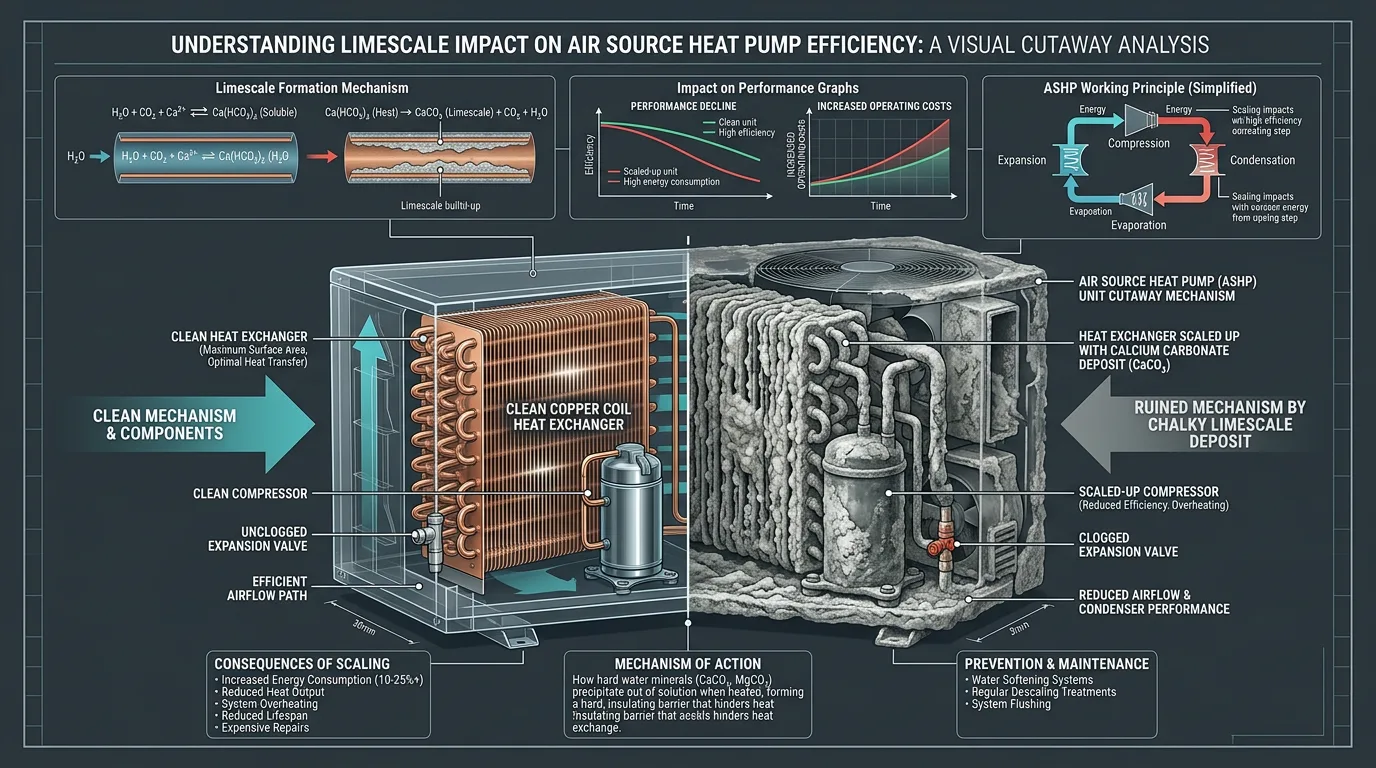
In this article
- 1. The Net-Zero Drive Meets the Cretaceous Chalk Aquifer
- 2. The Thermodynamics of Fouling: The 1mm Thermal Barrier
- 3. Brazed Plate Heat Exchangers (PHE) vs. Victorian Gas Cast-Iron
- 4. Legionella Cycling: The 60°C Flash Precipitation Shock
- 5. The Manufacturer Warranty Loophole: Clause 4.2
- 6. Pre-Purchase Verification: The 4-Step Heat Pump Hardness Audit
- Official Research Sources & Citations
1. The Net-Zero Drive Meets the Cretaceous Chalk Aquifer
Across the United Kingdom, estate agent listings are filled with green sustainability accolades: "Fitted with state-of-the-art Daikin/Mitsubishi Air Source Heat Pump (ASHP) — zero gas reliance, EPC Rating B." Buyers assume they are inheriting a low-maintenance, ultra-efficient heating system that will last 20 years.
However, over 60% of England—including London, the Thames Valley, East Anglia, Surrey, and Hampshire—sits directly above extensive geological formations of Cretaceous chalk and limestone. As groundwater perches in and permeates through these calciferous strata, it dissolves calcium ($Ca^{2+}$) and magnesium ($Mg^{2+}$) bicarbonate ions, delivering municipal tap water with hardness ratings between 280 and 380 ppm (parts per million).
While old gas combi boilers tolerated this mineral burden through sheer brute thermal output (burning gas at over 1,000°C), modern air-source heat pumps operate on tight thermodynamic margins where water chemistry is life or death.
2. The Thermodynamics of Fouling: The 1mm Thermal Barrier
Heat pumps operate via the Carnot refrigeration cycle, extracting ambient thermal energy from outdoor air and transferring it to domestic hot water via a refrigerant-to-water heat exchanger. Their thermodynamic performance is measured by the Coefficient of Performance (COP):
COP = Thermal Heat Delivered (kW) / Electrical Energy Consumed (kW)
A well-commissioned modern heat pump delivers a Seasonal COP (SCOP) between 3.2 and 4.0 (for every 1 kW of electricity consumed, it outputs 3.5 kW of heat). But calcium carbonate ($CaCO_3$) has a thermal conductivity of roughly 2.2 W/m·K, compared to copper at 385 W/m·K and stainless steel at 16 W/m·K.
| Limescale Layer Thickness | Thermal Transfer Degradation | Compressor Head Temperature | Annual Electricity Bill Penalty |
|---|---|---|---|
| 0.5 mm | -9.5% | +4.2°C | +£185 / year |
| 1.0 mm | -18.0% | +8.6°C | +£360 / year |
| 2.0 mm | -34.8% | +16.1°C | +£690 / year |
Just one millimeter of chalk mineral crust on the heat exchanger surfaces can cut heat-transfer efficiency by 7-10%, eroding the efficiency that justified the installation in the first place.
3. Brazed Plate Heat Exchangers (PHE) vs. Victorian Gas Cast-Iron
Why didn't old boilers die this quickly? Old gas boilers relied on wide-bore cast-iron or heavy copper waterways with clearances measured in centimeters. If 2mm of scale deposited inside the heat exchanger, flow rates suffered slightly, but water continued to circulate.
In stark contrast, modern high-efficiency heat pumps utilise Brazed Plate Heat Exchangers (BPHE). These comprise dozens of corrugated, razor-thin (0.3mm) stainless steel plates braze-welded with nickel or copper. The fluid channels between plates are microscopic—frequently less than 1.8 to 2.4 millimeters wide.
When chalk-heavy water circulates through these micro-corrugated channels, turbulent thermal boundaries cause calcium carbonate to precipitate directly into the crevices. Within 30 to 36 months, the heat exchanger is not merely scaled—it is hydraulically throttled. The circulator pump cavitates, high-pressure refrigerant trip codes trigger (Fault Codes E3, 7H, or HP error), and the entire unit shuts down in the dead of winter.
4. Legionella Cycling: The 60°C Flash Precipitation Shock
Heat pumps run the central heating circuit at low temperatures (typically 35°C to 45°C), where limescale remains relatively stable in solution. However, UK building regulations and the Water Supply (Water Fittings) Regulations 1999 mandate weekly anti-legionella disinfection cycles, forcing domestic hot water storage cylinders up to 60°C – 65°C.
Calcium carbonate possesses an unusual property known as retrograde solubility: unlike sugar or salt, calcium carbonate becomes LESS soluble as water temperature increases.
Every time the heat pump's electric immersion booster fires to reach 60°C for the anti-legionella cycle, dissolved calcium carbonate undergoes rapid flash-precipitation, encasing the immersion coil and cylinder heat exchanger spiral in rock-hard crystalline aragonite scale. In hard water areas like Thames Water, Affinity Water, or Anglian Water zones, an unsoftened immersion heater will burn out within 18 to 24 months.
5. The Manufacturer Warranty Loophole: Clause 4.2
When homeowners call out the installer or manufacturer under the much-touted 7-year or 10-year warranty, they are hit with a harsh reality: Manufacturer fine print universally excludes limescale damage.
Under Daikin, Vaillant, Worcester Bosch, and Mitsubishi installer terms, warranty validity is strictly conditional upon water quality compliance:
- Water hardness must not exceed 200 ppm ($CaCO_3$ equivalent).
- System must be commissioned according to BS 7593:2019 (Code of practice for the preparation, commissioning and maintenance of domestic central heating systems).
- Inline magnetic/scale filtration and chemical inhibitor dosing (e.g. Fernox F1 / Sentinel X100) must be certified annually.
Replacing a choked brazed plate heat exchanger and burnt-out immersion element out of warranty costs between £1,800 and £2,450, including refrigerant recovery and recalibration.
6. Pre-Purchase Verification: The 4-Step Heat Pump Hardness Audit
If you are buying or renting a property with a heat pump installed in England:
- Verify the Outward Postcode Water Hardness: Run the property address through HabitatReport to obtain the exact statutory DWI laboratory hardness (ppm and Clarke degrees). If hardness exceeds 200 ppm, a dedicated ion-exchange water softener is non-negotiable.
- Inspect the Plant Room for an Ion-Exchange Softener: Look for a dual-tank block salt water softener installed upstream of the unvented cylinder. Warning: cheap magnetic clamps or electronic pulse devices do not satisfy manufacturer warranty clauses.
- Request the BS 7593 Commissioning Log: Demand the benchmark commissioning document from the vendor's conveyancer showing date of inhibitor treatment and water hardness baseline test.
- Deploy the £2,200 Conveyancing Repair Allowance: If the property has an unsoftened heat pump operating for over 2 years in a 250+ ppm zone, request a £1,500–£2,200 retention credit for full chemical power-flushing, plate heat exchanger replacement, and WRAS-approved water softener integration.
Official Research Sources & Citations
All technical specifications, thermodynamic fouling coefficients, and regulatory standards cited in this guide are cross-referenced from statutory engineering repositories:
- British Standards Institution (BSI): BS 7593:2019 — Code of practice for preparation, commissioning and maintenance of domestic central heating and cooling water systems.
- DWI (Drinking Water Inspectorate UK): Annual Chief Inspector’s Drinking Water Quality Datasets — Public Water Supply Hardness & Mineral Aggressiveness Indices (2022–2025).
- CIBSE (Chartered Institution of Building Services Engineers): CIBSE AM16: Heat Pump Installations for Large and Domestic Properties — Plate Heat Exchanger Scaling Dynamics.
- UK Department for Energy Security and Net Zero (DESNZ): Boiler Upgrade Scheme (BUS) Statistics & Technical Installation Commissioning Standards.
- International Journal of Refrigeration: M. Gudmundsdottir et al., "Fouling Mechanisms in Brazed Plate Heat Exchangers in Hard Water Domestic Heat Pump Applications" (Elsevier Science).
- UK Water Supply (Water Fittings) Regulations 1999: Schedule 2, Section 8 — Prevention of Scale & Bacterial Amplification in Stored Hot Water.
Check Any UK Property's Exact Water Hardness & Heat Pump Risk
Don't let a £2,200 heat exchanger failure ruin your move. Enter your postcode on HabitatReport to reveal verified municipal water hardness (ppm), statutory DWI water testing records, and HVAC risk metrics instantly.
Scan UK Property Now →