The 1970–1995 Plastic Pipe Timebomb: Polybutylene & Unstabilized Polymers in Mid-Century Homes
Buyers hunting for homes built between 1978 and 1995 often congratulate themselves on avoiding Victorian lead pipes. What they inherit instead is an unstabilized plastic polymer that reacts with municipal chlorine, micro-fractures from within, and detonates behind bathroom walls without warning.
In this article
- 1. The "Miracle Plastic" of the 1980s Housing Boom
- 2. The Radical Scission Chemistry: Chlorine Meets Polybutylene
- 3. The Outside Looks Pristine: Why Visual Surveys Never Catch It
- 4. The Insurance Blacklist: Why Claims Get Denied
- 5. UK vs. US Variants: Quest, Hep2O First-Gen, and Acetal Fittings
- 6. Pre-Purchase Verification: Identifying the Stamp Codes
- Official Research Sources & Citations
1. The "Miracle Plastic" of the 1980s Housing Boom
Between 1978 and the mid-1990s, residential developers across the United States and the United Kingdom faced skyrocketing copper prices. Chemical manufacturers stepped forward with what was hailed as a revolutionary polymer: Polybutylene (PB-1), frequently marketed under commercial trade names like Quest in North America and early grey flexible piping variants across the UK.
Polybutylene was flexible, freeze-tolerant, cheap, and easily installed using crimp rings or push-fit acetal fittings. Over 10 million homes were fitted with polybutylene supply lines. Builders and early buyers celebrated the death of corroded copper.
Within a decade, that optimism turned into one of the largest construction class-action settlements in civil engineering history ($1+ billion in Cox v. Shell Oil Co.).
2. The Radical Scission Chemistry: Chlorine Meets Polybutylene
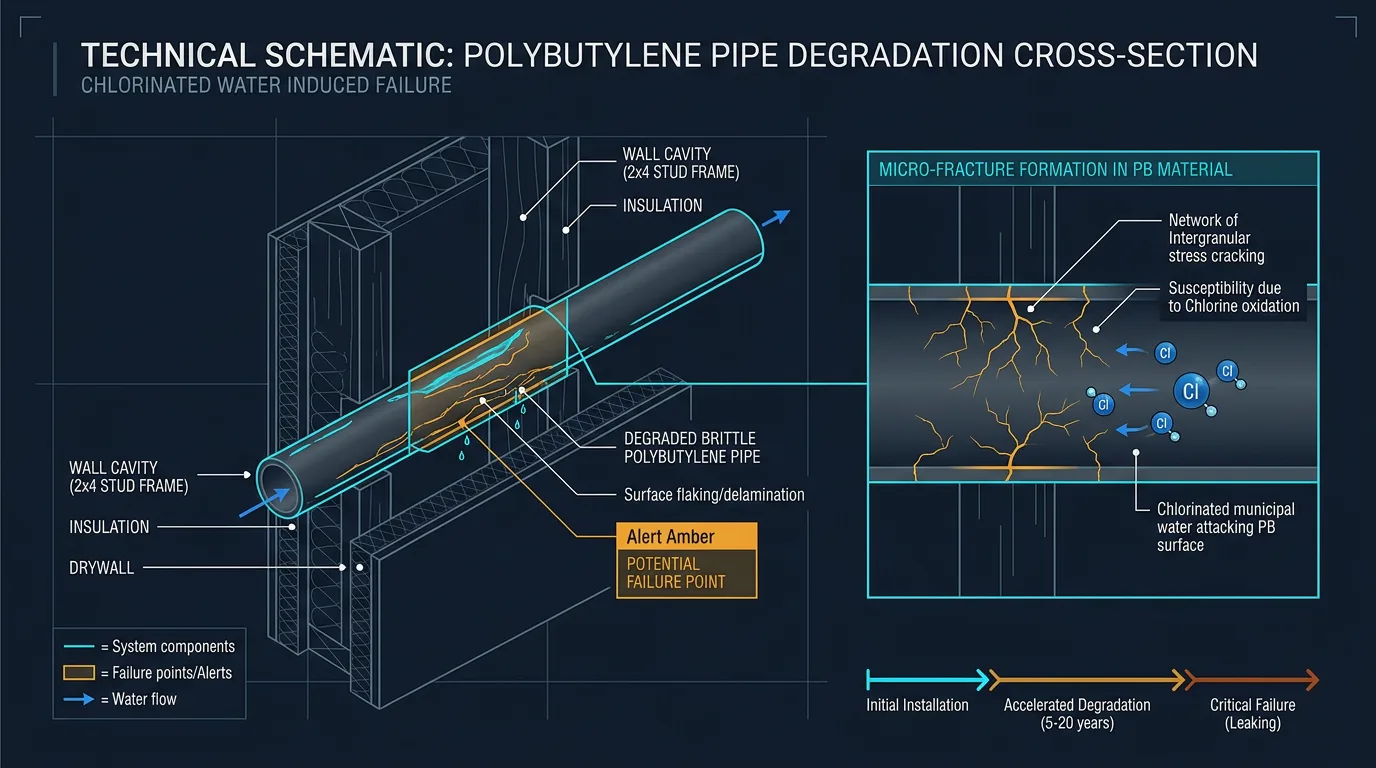
The fatal flaw of polybutylene is not mechanical—it is chemical. Municipal water utilities rely on chemical disinfectants—primarily free chlorine ($Cl_2 / HOCl$) and monochloramine ($NH_2Cl$)—to kill pathogens in the distribution main.
When municipal tap water enters a polybutylene pipe, hypochlorous acid directly attacks the polymer chains via free-radical chain scission:
HOCl + Polymer-H → Polymer• + Cl- + H2O (Oxidative Embrittlement)
Chlorine leaches out the chemical plasticizers and anti-oxidant stabilizers added during extrusion. As the inner wall loses elasticity, micro-cracks form along the molecular grain. Over time, these micro-fractures propagate outwards through the pipe wall in a process called Environmental Stress Cracking (ESC).
| Service Life | Internal Polymer Condition | Tensile Strength Loss | Failure Probability |
|---|---|---|---|
| Years 1 – 5 | Smooth internal surface; micro-oxidation beginning | < 5% | Very Low (<1%) |
| Years 6 – 12 | Chalky white degradation layer; micro-fissuring | 15% – 30% | Moderate (12%) |
| Years 15 – 30+ | Deep longitudinal stress cracks; brittle polymer core | > 65% | Critical (>85%) |
3. The Outside Looks Pristine: Why Visual Surveys Never Catch It
The most sinister property of polybutylene degradation is that degradation occurs exclusively from the inside out.
A surveyor inspecting the pipe under a bathroom vanity or near the hot water tank sees a clean, flexible, grey or blue pipe with zero external signs of wear. The pipe does not rust, green, or corrode. It looks virtually brand new.
Inside the pipe wall, however, the polymer has degraded into a brittle crystalline crust barely 0.5mm thick holding back 45 to 60 PSI of municipal water pressure. A minor water-hammer pulse (e.g. from a washing machine solenoid valve shutting) instantly bursts the embrittled pipe wall, releasing 1,500 liters of water per hour directly between joists.
4. The Insurance Blacklist: Why Claims Get Denied
In both the US and UK, insurance underwriters maintain rigorous loss-prevention algorithms. Because the average polybutylene failure results in £12,000 to $35,000 in catastrophic water damage (destroying ceiling drywall, hardwood floors, and electrical circuits), insurers have hardened their terms:
- Coverage Refusals: Major underwriters (State Farm, Allstate, Aviva, AXA) routinely decline property coverage upon discovering polybutylene plumbing during the 4-point inspection or underwriting questionnaire.
- Policy Riders & Water Damage Exclusions: Policies that do accept the home often carry a strict exclusion rider: "Any loss or damage resulting from the failure or burst of polybutylene piping is strictly excluded from coverage."
- Mortgage Lending Roadblocks: Because mortgage lenders require comprehensive buildings insurance as a condition of mortgage drawdown, an uninsurable plumbing system can collapse an ongoing property transaction days before completion.
5. UK vs. US Variants: Quest, Hep2O First-Gen, and Acetal Fittings
While the class-action drama centered on North American Quest (PB2110) pipes with grey tubing, the United Kingdom experienced its own version of the crisis:
- Early Push-Fit Acetal Fittings: Early UK installations used mechanical push-fit fittings with acetal plastic grab rings. The combination of hot water (>60°C) and chlorine caused the plastic teeth to fracture, causing pipes to push out of elbow joints under pressure.
- First-Generation Barrierless Polybutylene: Early UK flexible grey pipes manufactured without an ethylene vinyl alcohol (EVOH) oxygen-barrier layer allowed atmospheric oxygen to permeate through the pipe wall into closed central heating systems, causing severe black iron oxide (magnetite) sludge that destroyed radiators and boiler circulator pumps.
6. Pre-Purchase Verification: Identifying the Stamp Codes
When inspecting any residential property constructed between 1978 and 1998:
- Inspect the Stopcock and Riser Lines: Look where the primary water service enters the property. Polybutylene is typically dull grey (rarely blue or black in early imports).
- Read the ASTM Stamping Code: Examine the printed text on the exterior pipe jacket. Watch for the designation "PB2110", "ASTM D-3309", or "Qest".
- Check Fitting Collars: If you see grey plastic pipes joined with white or grey plastic insert nuts rather than crimped copper or modern brass compression fittings, assume failure is imminent.
- Deploy the £4,500 Full-Home Repipe Credit: Replacing polybutylene requires opening wall chases and rerouting modern PEX-a (cross-linked polyethylene) or copper pipework throughout the home. Use HabitatReport's verified age and materials diagnostic to request a formal £3,500 – £5,500 ($4,500 – $7,000) repair allowance in your conveyancing inquiries before signing the contract.
Official Research Sources & Citations
Forensic polymer engineering datasets and plumbing failure litigation records cited in this study are drawn from peer-reviewed scientific and legal repositories:
- ASTM International: ASTM D3309: Standard Specification for Polybutylene (PB) Plastic Hot- and Cold-Water Distribution Systems (Withdrawn Historical Standard).
- Society of Plastics Engineers (SPE): A. Lustiger & M. Markham, "Chlorine-Induced Degradation of Polybutylene Plumbing Piping Systems" (ANTEC Proceedings).
- National Association of Home Builders (NAHB Research Center): "Evaluation of Polybutylene Pipe Performance in Domestic Potable Water Applications."
- U.S. Federal District Court Records: Cox v. Shell Oil Company, et al. (Civil Action No. 18844) — National Polybutylene Class Action Settlement Documentation.
- Water Research Foundation (WRF): Report #91157: "Impact of Disinfectants on Degradation of Polymeric Plumbing Materials."
- Chartered Institute of Plumbing and Heating Engineering (CIPHE UK): Technical Advisory Bulletin: "Inspection and Risk Assessment of First-Generation Polybutylene Systems in Domestic Dwellings."
Check Your Property's Age & Plumbing Risk Profile
Don't let an uninsurable plastic pipe disaster ruin your purchase. Enter any property address on HabitatReport to reveal construction age profiles, municipal water disinfectant chemistry, and plumbing due diligence metrics.
Scan Property Plumbing Risks →