The 3-Degree Glideslope Trap: Why Homes 6 Miles From Heathrow & LAX Suffer 72 dB Low-Frequency Aviation Noise
Homebuyers routinely assume that living 5 to 10 miles away from an international airport guarantees acoustic tranquility. In reality, the geometry of the standard 3.0° Instrument Landing System (ILS) glideslope and dirty aerodynamic configurations generate roof-rattling low-frequency rumble across supposedly quiet suburbs.
In this article
- 1. The Distance Illusion: The Geometry of the 3° Glideslope
- 2. The "Dirty Airframe" Transition: Flaps, Slats, and Landing Gear
- 3. Low-Frequency C-Weighted Rumble vs. Double Glazing
- 4. The Weather Rotation Trap: Westerly Preference & Inversion Layers
- 5. The Health Toll: Cortisol Spikes, Sleep Fragmentation, and WHO Benchmarks
- 6. Pre-Offer Acoustic Defense: How to Audit Flight Paths Before Bidding
- Official Research Sources & Citations
1. The Distance Illusion: The Geometry of the 3° Glideslope
When searching for a family home, property buyers often set a mental buffer zone: "As long as we are at least 5 miles from the airport fence, aircraft noise won't be an issue." This assumption leads tens of thousands of buyers into expensive traps in prestigious enclaves such as Richmond, Kew, Putney, and Fulham in London, or Inglewood, Culver City, and Glendale in Southern California.
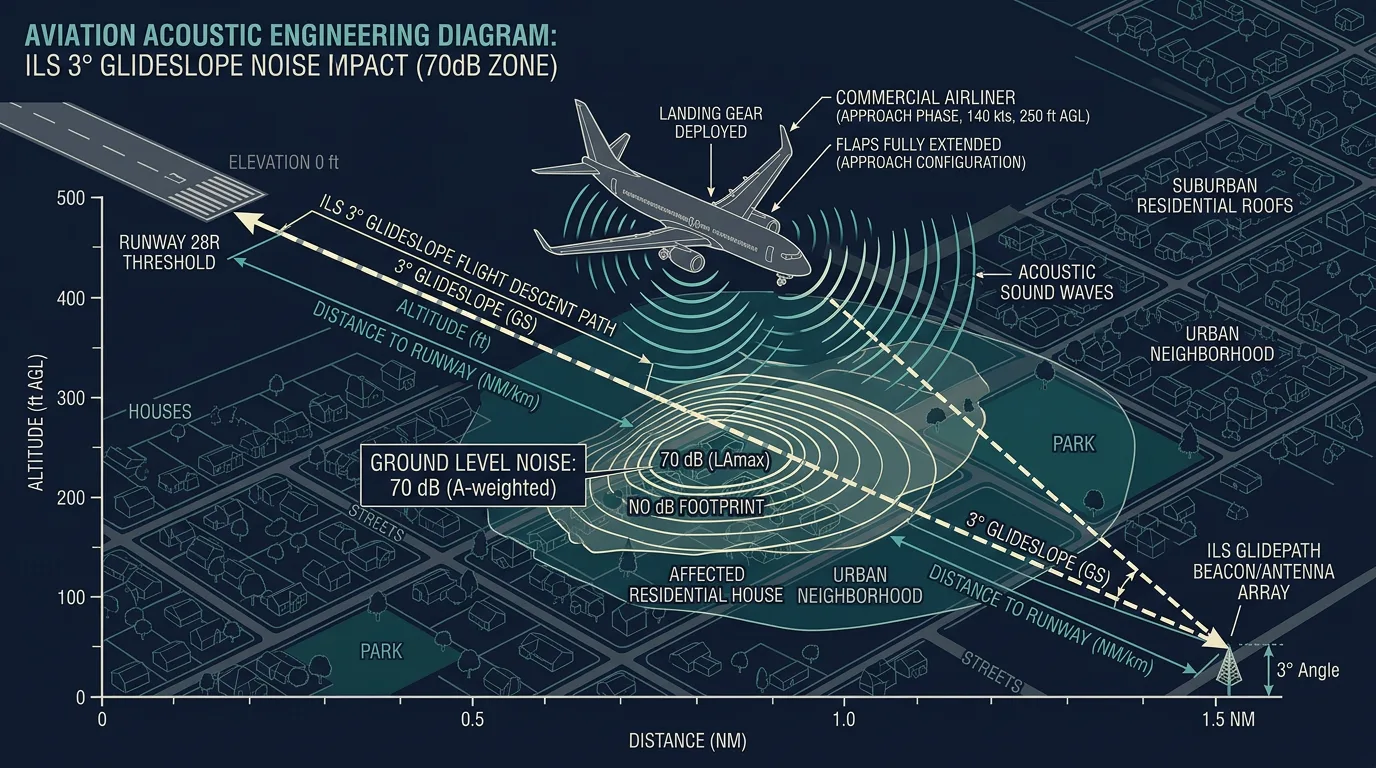
Under International Civil Aviation Organization (ICAO) and Federal Aviation Administration (FAA) operational guidelines, commercial airliners lock onto an Instrument Landing System (ILS) Glideslope fixed at a 3.0° descent angle.
Simple trigonometry dictates the altitude ($h$) of an arriving Airbus A380, Boeing 777, or 787 based on distance ($d$) from the runway threshold:
Altitude (ft) ≈ Distance (Nautical Miles) × 318 ft/NM
| Distance from Runway | Aircraft Altitude AGL (Above Ground Level) | Typical Suburbs Affected | Peak Ground Noise Level (dBA) |
|---|---|---|---|
| 2.5 miles (4 km) | ~750 – 850 ft (240 m) | Hounslow, Inglewood | 78 – 84 dB(A) |
| 6.0 miles (10 km) | ~1,800 – 2,000 ft (580 m) | Richmond, Kew, Culver City | 68 – 74 dB(A) |
| 10.0 miles (16 km) | ~3,100 – 3,300 ft (975 m) | Fulham, Putney, Mid-City LA | 62 – 68 dB(A) |
At 6 miles out, a twin-aisle heavy airliner is flying barely 1,900 feet above living rooms every 90 seconds during peak arrival flows.
2. The "Dirty Airframe" Transition: Flaps, Slats, and Landing Gear
Crucially, noise is not purely generated by jet engine thrust. During the final approach, modern high-bypass turbofans (such as the Rolls-Royce Trent or GE90) are throttled back to low power settings. The primary source of ground-shaking disturbance is aerodynamic airframe noise.
Between 5 and 7 miles from touchdown, pilots execute the standard arrival checklist:
- Deploying Leading-Edge Slats and Trailing-Edge Flaps: Extending these mechanical wing surfaces interrupts smooth airflow, generating massive vortex turbulence and intense tonal shear noise.
- Lowering the Landing Gear: Massive multi-wheel bogies (such as the 16-wheel main gear of an A380 or 12-wheel gear of a B777) drop into the 160-knot airstream. The resulting turbulent bluff-body wake produces a severe acoustic boom that radiates directly downwards.
If your prospective property lies directly beneath the point where airlines routinely deploy landing gear (typically 5 to 7 nautical miles from the threshold), you will experience louder aerodynamic buffeting than residents located closer to the runway where gear is already deployed.
3. Low-Frequency C-Weighted Rumble vs. Double Glazing
Estate agents routinely reassure buyers: "The house has modern acoustic double glazing, so you won't hear a thing."
This statement confuses high-frequency attenuation with low-frequency acoustic dynamics. Standard acoustic glass (e.g. 6mm toughened glass / 12mm cavity / 4mm glass) is tested and rated using A-weighted decibels (dBA), which mimics human ear sensitivity to high-pitched sounds (1,000 to 4,000 Hz).
However, heavy aircraft vortex wake and jet bypass rumble consist of low-frequency acoustic energy between 31.5 Hz and 125 Hz (measured on the dBC or C-weighted scale). Low-frequency sound waves possess wavelengths between 3 and 10 meters. They pass straight through double glazing, enter building cavities, and induce structural resonance in timber roof trusses, suspended ceilings, and internal stud walls.
Even with closed windows, residents experience a physical chest-vibrating rumble and rattling picture frames that acoustic double glazing cannot stop without costly secondary asymmetric acoustic glazing (e.g. 10.8mm acoustic laminate with a 100mm air gap).
4. The Weather Rotation Trap: Westerly Preference & Inversion Layers
Why do thousands of buyers fail to notice this during their viewings?
Most viewings last 20 to 30 minutes on a Saturday afternoon. If the wind is blowing from the east on that particular day, major airports like London Heathrow operate in Easterly Operations (Runway 09L/09R), meaning aircraft arrive over Windsor and depart over London. Suburbs like Richmond, Barnes, and Putney are completely silent.
However, Heathrow operates under a statutory Westerly Preference (~70% of the year). When prevailing Atlantic winds resume, arrivals instantly switch to Runway 27L/27R, funneling up to 650 heavy aircraft directly over South West London from 06:00 AM until 23:30 PM. Furthermore, morning thermal inversion layers trap sound energy near the ground, amplifying perceived loudness by up to 6 to 9 dB.
5. The Health Toll: Cortisol Spikes, Sleep Fragmentation, and WHO Benchmarks
The World Health Organization (WHO) Environmental Noise Guidelines for the European Region (2018) strongly recommend reducing aircraft noise levels below 45 dB $L_{den}$ (day-evening-night average) and 40 dB $L_{night}$.
Epidemiological research led by the Imperial College London Small Area Health Statistics Unit (SAHSU) studied 3.6 million residents living beneath Heathrow flight paths and documented statistically significant elevations in:
- Cardiovascular Hospital Admissions: A 10–20% higher risk of stroke, coronary heart disease, and cardiovascular disease in areas with daytime noise >63 dB and night noise >55 dB.
- Nocturnal Cortisol Arousal: Night-time overflights trigger involuntary sympathetic nervous system activation, elevating arterial blood pressure and sleep fragmentation even when subjects remain asleep.
6. Pre-Offer Acoustic Defense: How to Audit Flight Paths Before Bidding
Before submitting a binding offer or exchanging contracts on any residential property:
- Map the ILS Extended Centerline: Draw a straight line 15 nautical miles out from the airport runway thresholds. If the property sits within 1.5 miles lateral distance of this vector, it is on the fixed glideslope.
- Inspect the HabitatReport Aviation Radar Overlay: Run the property address on HabitatReport to reveal whether it falls within the 65+ dB contour, the exact radar-tracked mean overflight altitude, and the CAA / FAA glideslope intercept.
- Verify Runway Alternation Schedules: At Heathrow, check whether the address benefits from half-day runway alternation (switching at 15:00 daily).
- Leverage the £3,500 Acoustic Glazing Concession: Use HabitatReport's Conveyancing Inquiry Draft to highlight the verified dB contour and request a £2,500–£4,000 allowance to upgrade bedroom windows to 16.8mm acoustic laminate secondary glazing.
Official Research Sources & Citations
Aviation acoustics, regulatory flight profiles, and epidemiological data cited in this guide are derived from statutory aviation and public health authorities:
- Civil Aviation Authority (CAA UK): CAP 1520: Airspace Design Guidance & CAP 2144: Aircraft Noise Exposure Contours for London Heathrow, Gatwick, and Stansted.
- Federal Aviation Administration (FAA US): Aeronautical Information Manual (AIM) — Section 1-1-9: Instrument Landing Systems (ILS) & Part 150 Airport Noise Compatibility Planning.
- World Health Organization (WHO): Environmental Noise Guidelines for the European Region (2018) — Chapter 3.1: Aircraft Noise Specific Recommendations.
- British Medical Journal (BMJ): A. Hansell et al., "Aircraft noise and cardiovascular disease near Heathrow airport in London: small area study" (BMJ 2013; 347:f5432).
- International Civil Aviation Organization (ICAO): Annex 16 to the Convention on International Civil Aviation — Environmental Protection, Volume I: Aircraft Noise.
- Department for Transport (DfT UK): Night Flight Restrictions at Heathrow, Gatwick and Stansted — Consultation & Statutory Instrument Regime.
Check Any Home's Exact Flight Path & Noise Decibel Level
Don't rely on a 30-minute quiet weekend viewing. Enter any UK postcode or US address on HabitatReport to see the verified aviation glideslope altitude, noise exposure contours, and environmental health diagnostics.
Scan UK Flight Path Exposure →