The Sticker on the Wall: What a "DANGER Asbestos" Label Actually Tells a Buyer — and What It Doesn't
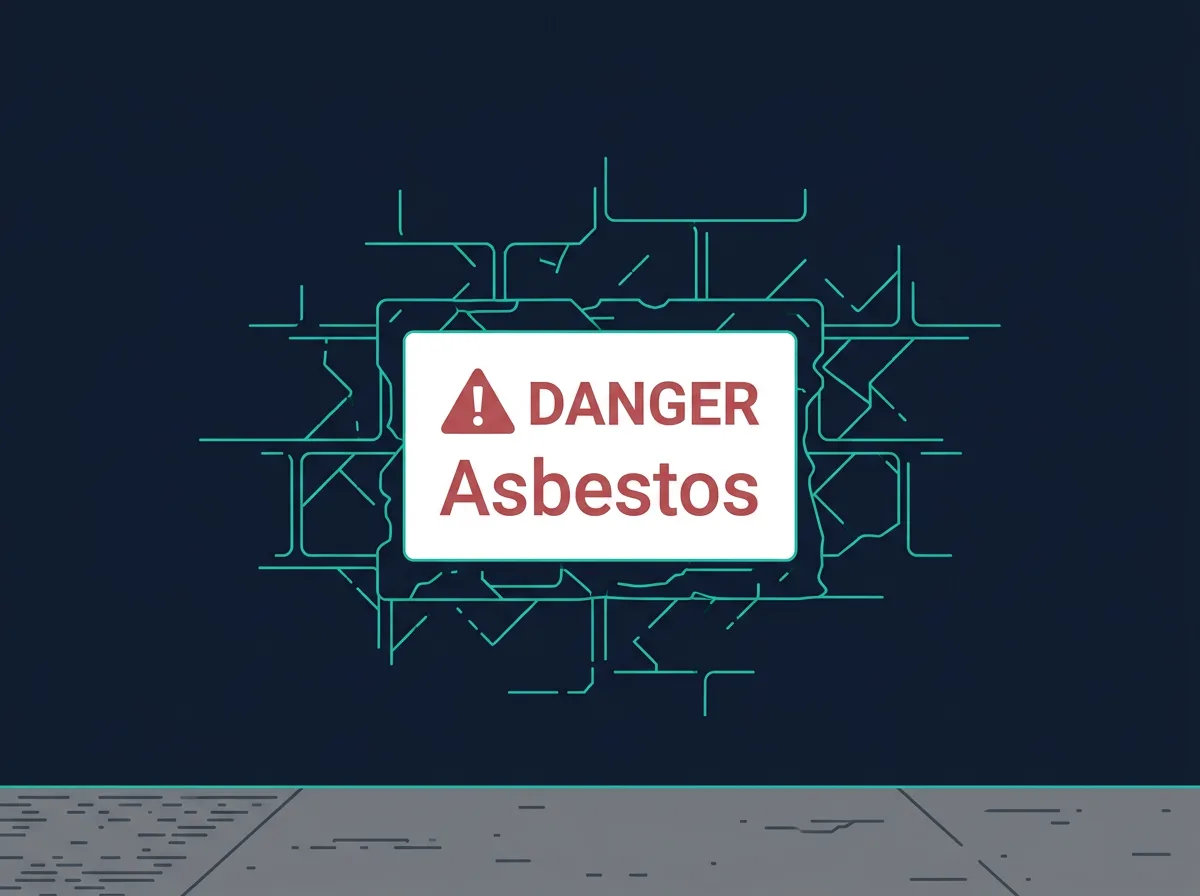
Somewhere in every viewing, behind the staging and the fresh paint, there is a small red sticker like this one — on a soffit, a garage ceiling, a boiler cupboard panel. It is not a diagnosis. It is not a survey. It is a single data point from decades ago that most buyers misread in both directions: panic where there is none, and complacency where there is plenty.
In this article
- 1. The Scale: 5,000 Deaths a Year, and Every Pre-2000 Building
- 2. What the Sticker Actually Certifies — and What It Doesn't
- 3. The Hierarchy of Risk: Fibre Type, Bonding, Condition, Location
- 4. Where It Hides: The Buyer's Spotter's List
- 5. Why RICS Surveys Flag but Never Test
- 6. The Survey Food-Chain: Management, Refurbishment, Demolition
- 7. The Economics: £150-£600 Now, or £20,000 Mid-Project
- 8. The Decision Framework: When to Walk, When to Renegotiate, When to Ignore
1. The Scale: 5,000 Deaths a Year, and Every Pre-2000 Building
Start with the numbers, because they are more alarming than the sticker: the Health and Safety Executive attributes around 5,000 deaths per year in Great Britain to past asbestos exposure — mesothelioma, asbestos-related lung cancer, and asbestosis combined. Mesothelioma alone, an almost exclusively asbestos-caused cancer of the organ linings, killed over 2,500 people in a single recent year. Asbestos remains the single greatest cause of work-related deaths in Britain.
Now the counterweight: asbestos can be found in any building built before the year 2000. The UK banned blue and brown asbestos (crocidolite and amosite) in 1985, but white asbestos (chrysotile) remained legal in building products until 1999. This means effectively the entire pre-2000 housing stock — the majority of UK homes — contains some asbestos somewhere. The sticker in the photo is not a rare find. It is the market normal.
The paradox that matters for buyers: the 5,000 deaths come overwhelmingly from occupational exposure decades ago — shipyards, power stations, lagging — not from intact asbestos-cement panels in garages. Domestic risk is real but governed entirely by condition and disturbance, which is what the rest of this article is about.
2. What the Sticker Actually Certifies — and What It Doesn't
A label like the one photographed tells you three things, and only three:
- Someone, at some point — a contractor, a landlord, a previous owner's surveyor — identified or suspected an asbestos-containing material (ACM) at or near this location.
- They took the minimum legally defensible step: warning of the hazard without characterising it. The sticker contains no fibre type, no condition assessment, no sample result, no date.
- Under the Control of Asbestos Regulations 2012, if this were a non-domestic building, a register entry and asbestos management plan would exist somewhere. In domestic premises, no such duty applies — which is exactly why buyers inherit the ambiguity.
What the sticker does not tell you: whether the material is asbestos-cement (low risk, bonded) or amosite board (higher risk, friable when cut); whether it is intact or delaminating; whether it was removed years ago with only the label left behind (common); or whether the label itself is simply a leftover from a long-demolished boiler flue. Labels outlive their referents. We have seen stickers on walls where the ACM was professionally removed a decade earlier and nobody re-inspected.
The buyer's correct read: a lead to investigate, not a verdict to price. Both the panic-buyer who walks and the relaxed-buyer who ignores it are making unpriced decisions.
3. The Hierarchy of Risk: Fibre Type, Bonding, Condition, Location
Asbestos risk is not binary. It is a four-variable function, and understanding it converts fear into arithmetic:
- Fibre type. Crocidolite (blue) and amosite (brown) are the aggressive fibres, associated with the steepest mesothelioma dose-response. Chrysotile (white) — the vast majority of what remains in housing — is less potent per fibre, though still a Group 1 human carcinogen.
- Bonding. Bonded (non-friable) materials — asbestos-cement sheets, floor tiles, textured coatings — lock fibres in a cement or resin matrix and release almost nothing while intact. Friable materials — sprayed coatings, lagging, AIB (asbestos insulating board) — crumble and shed fibres under ordinary contact.
- Condition. Intact, painted, sealed ACMs in good condition are effectively passive. Damaged, water-stained, drilled, sanded or crumbling ACMs are active fibre sources. The sticker on a weathered, cracked soffit board means something very different from the same sticker on an intact one.
- Location. An ACM behind a sealed soffit nobody touches is a managed liability. The same material in a garage ceiling next to where children play, or on a boiler flue a contractor will drill into next month, is a live one.
The practical grading: exterior asbestos-cement (roof sheets, soffits, garage walls, rainwater goods) is the lowest-risk category in housing — it is 10-15% chrysosil in a dense cement matrix. Artex-style textured coatings on ceilings (common pre-1999) are low-risk while undisturbed, but every DIY drill, screw or sanding job releases fibres. AIB around boilers, fire doors and ceiling voids is the middle tier — friable, higher-fibre-content, frequently disturbed by trades. Sprayed lagging and coatings on structural steel and pipes are the top tier — largely removed from housing, but present in converted flats and 1960s-70s system builds.
4. Where It Hides: The Buyer's Spotter's List
A viewing checklist costs nothing and catches 80% of what a survey would later flag. The high-frequency ACM locations in UK housing, by era:
- Pre-1950: lagging on pipework and boilers; some decorative coatings; ironing-board stands and oven gloves (sic — the density of asbestos in domestic products peaked earlier than people assume).
- 1950-1980 — the peak decades: AIB partition walls and ceiling tiles, sprayed coatings on steel, boiler and flue components, pipe lagging, water tanks (asbestos-cement cisterns), garage and shed roofing, floor tiles (vinyl with asbestos backing).
- 1980-1999: mostly chrysotile in bonded products — textured ceiling coatings, cisterns, some cement sheets, brake pads and glazing seals. Volume declines, presence does not end.
Five tells at a viewing: a corrugated grey garage or shed roof with a wavy profile (almost always asbestos-cement if pre-2000); textured ceilings with a stippled or swirled pattern (Artex-era, likely chrysotile); a grey panel behind an old boiler or in a fire-door core; old vinyl floor tiles 9-inch or 12-inch with a fibrous backing; and — the one in the photo — any red warning label, which should be treated as a request for the property's asbestos records, not as a terminus.
5. Why RICS Surveys Flag but Never Test
This is the structural gap that surprises most buyers. The RICS HomeBuyer Report (Level 2) and Building Survey (Level 3) are visual, non-invasive inspections: the surveyor reports "asbestos-containing materials are likely present at [locations]" and recommends further investigation. They do not sample, and they cannot — sampling means breaking the material, which the surveyor is not authorised to do in an occupied property they do not own.
The result is a systematic passing of the buck: the RICS survey says "get an asbestos survey", the conveyancer says "that's a survey matter", the estate agent says "the seller has no records". Everyone is correct; the buyer is left with a flag and no data. This is the same structural blind spot documented in our guides on radon and polybutylene — the market assigns inspection duties to whoever notices, and no one is accountable for the gap between "flag" and "verdict".
Note the asymmetry with the seller's side: under the Consumer Protection from Unfair Trading Regulations, sellers and agents must not withhold known material information — a known asbestos register entry, prior removal invoices, or survey flags. But "known" is doing heavy lifting: if nobody ever sampled, nobody "knows", and nothing is disclosed. Silence is not concealment in this regime.
6. The Survey Food-Chain: Management, Refurbishment, Demolition
UK asbestos surveys come in two legal types under HSG264 (asbestos: The survey guide), and knowing which one you need is where most buyers overpay or under-protect:
- Management Survey — the standard, non-intrusive inspection: locates ACMs likely to be disturbed during ordinary occupation and maintenance. This is the buyer's default. It samples representative materials, gives fibre-type identification (polarised light microscopy at a UKAS lab) and a condition/ priority rating. Cost: roughly £150-£600 for a typical house depending on size and age.
- Refurbishment/Demolition Survey — legally required before any intrusive building work: wall removal, bathroom refits, rewires, extensions. It is destructive by design — opening up floors, ceilings and voids to find every ACM that the works would disturb. Cost: roughly £250-£900, and it must be done before contractors arrive, not after the first wall comes down.
Sampling is priced separately: typically £140-£180 for the first sample (which includes UKAS lab analysis and a written certificate) and around £45 per additional sample. For a targeted question — "is this soffit board asbestos?" — a single-sample call-out can be cheaper than a full survey, and it converts the sticker from a rumour into a laboratory result.
US readers: the equivalent is an AHERA-licensed inspector ($200-$600 residential), with NESHAP and state rules governing removal; mandatory pre-renovation testing applies in most states, and disclosure of known asbestos is required at sale in many jurisdictions.
7. The Economics: £150-£600 Now, or £20,000 Mid-Project
The financial case is unusually lopsided. The documented failure mode: a buyer skips the survey to "save" £500, then during a kitchen refit or rewire the contractor cuts into an AIB panel. Work stops. A licensed asbestos contractor must be engaged (general builders cannot legally remove friable ACMs above threshold quantities), the affected area is sealed, air monitoring and clearance testing follow, the project schedule slips weeks, and the contractor claims delay costs. Realistic total: £8,000-£20,000+ for an incident that a £150-£600 survey would have prevented — the trade documented in one UK case study as a £500 "saving" producing £20,000 of emergency costs.
Conversely, when ACMs are found intact and bonded, the correct response is almost always management, not removal. HSE guidance is explicit: removal of good-condition asbestos-cement is often unnecessary and can be riskier than leaving it, because removal is the disturbance. Encapsulation, sealing and periodic re-inspection are the standard remedies. Buyers should be suspicious of any contractor whose first recommendation for an intact garage roof is full removal.
Licensed removal costs for reference: asbestos-cement garage roofs run £800-£2,000; AIB ceiling or partition removal £1,500-£5,000; extensive lagging removal in converted buildings can exceed £10,000. Disposal is to licensed landfill, and the paperwork (waste consignment notes) is part of the legal chain of custody.
8. The Decision Framework: When to Walk, When to Renegotiate, When to Ignore
Synthesising the above into the decision a buyer actually faces when they see the sticker — or the garage roof, or the textured ceiling:
- Walk away — only when friable ACMs (sprayed coatings, damaged AIB) are widespread, actively deteriorating, and the seller refuses both records and survey access. This is rare. Everything else is negotiable arithmetic.
- Renegotiate — when a management survey or targeted sampling confirms ACMs that a plausible purchase plan (extension, rewire, refit) would disturb. The lever is the refurbishment survey cost plus the quoted removal, plus schedule risk — routinely a £2,000-£8,000 adjustment on the asking price, evidenced by the survey document itself. This is the strongest version of the price-renegotiation playbook: a laboratory certificate is the hardest form of leverage.
- Ignore (properly) — when sampling confirms bonded asbestos-cement in good condition in a location no planned works will touch. Record it, paint over the label edges if they're peeling, inform future contractors, and re-inspect annually. This is what "managing asbestos" means in housing — and it costs nothing but a file note.
The meta-lesson mirrors this site's core thesis: environmental hazards in property are rarely the binary the marketing suggests. The red sticker is not a poison symbol; the missing sticker is not a clean bill. The data — a £45 sample, a £300 survey — is cheap, and the mispricing of that data by everyone else in the transaction is precisely where the informed buyer captures value.
📑 Buying a pre-2000 flat or house?
Run a free property health scan on your address — water quality, air, and area risk in one report, so the asbestos sticker is never the only signal you're negotiating with.
🔍 Scan your property free → 🧩 Get the Chrome Extension →Official Research Sources & Citations
- HSE — Asbestos homepage: "Asbestos can be found in any building built before the year 2000 and causes around 5,000 deaths every year" (hse.gov.uk/asbestos)
- HSE — Asbestos-related disease statistics, Great Britain 2025 (mesothelioma mortality trends; exposure predominantly pre-1980)
- Control of Asbestos Regulations 2012 — duty to manage (non-domestic), survey types per HSG264: The Survey Guide
- HSE — Managing asbestos in buildings; HSG264 management vs refurbishment/demolition survey definitions
- UKAS-accredited laboratory analysis (polarised light microscopy) — sampling and certificate costs per market rate surveys, 2026
- RICS — Home Survey Standard (Level 2 HomeBuyer Report, Level 3 Building Survey): visual, non-invasive; ACMs flagged, not tested