Radon and buying a house: what to check and when to test
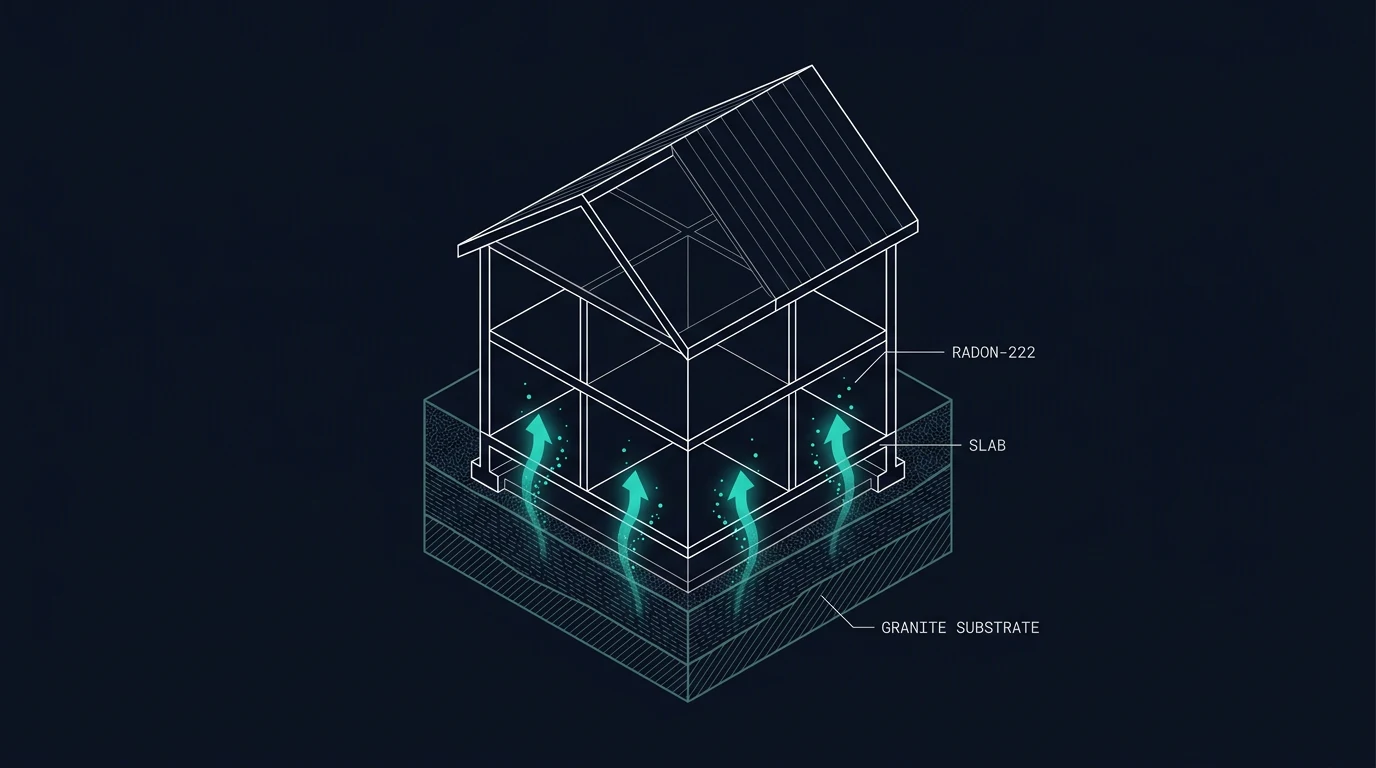
Radon is a naturally occurring radioactive gas that seeps up from the ground into buildings. It has no smell, colour or taste, so the only way to know the level in a particular building is to measure it. This guide explains how the official maps work, what the numbers mean, and when a three-month test is worth arranging before you commit to a purchase.
What radon is, in plain terms
Radon forms when small amounts of uranium decay in rocks and soil. It is present everywhere at low levels, and the level indoors depends mostly on what the ground is made of and how the building sits on it. Certain geology — granite areas such as Cornwall, Devon and parts of the Pennines and the Highlands, and some limestone and ironstone areas in the Midlands — produces more of it.
Because radon comes from the ground, the rooms in contact with the ground usually have the highest concentrations. Cellars and basements are a different case: UKHSA advises that any occupied basement should be monitored regardless of what the map shows for the area.
How the UK radon map works
The map is published by the UK Health Security Agency with the British Geological Survey. It does not measure individual buildings. It divides Great Britain into 1 km grid squares and gives each square a class based on the highest radon potential found anywhere inside it.
That detail matters. A single square can contain a street on clay and a farm on granite, and both get the same shading. UKHSA describes the map as indicative rather than definitive, and it should not be read as a prediction for one address.
The classes describe the estimated share of homes above the action level:
- White areas: under 1% of homes estimated above the action level.
- Shaded areas: 1% or more, rising through successive bands to more than one home in three in the darkest areas.
"Radon affected area" has a specific meaning: 1% or more of homes are estimated to be at or above the action level. It is a statement about a population of homes, not about the one you are buying.
HabitatReport shows the affected-area share for the area around a postcode on the free check at /check, using the same BGS and UKHSA data.
The action level and the target level
The UK action level is 200 becquerels per cubic metre (Bq/m³), as an annual average. UKHSA recommends that levels should be reduced in homes where the average is at or above this figure.
The target level is 100 Bq/m³, described by UKHSA as the ideal outcome for remedial work in existing buildings and for protective measures in new ones. Where a result falls between the two, UKHSA suggests that action should be considered, particularly if there is a smoker or ex-smoker in the household.
Both levels refer to an annual average, which is why measurements run for three months rather than a few days.
How to test a specific address
There are three routes, in order of effort.
1. Check the area first. The UKHSA address search produces a Radon Risk Report for a single property for £3.90 including VAT, telling you whether it sits in an affected area. The interactive map on ukradon.org is free.
2. Ask the seller. The property information form in England and Wales asks whether a radon test has been carried out, and a seller who has one should attach the report. An existing three-month result from the same building is more useful than any area-level figure.
3. Measure the building. UKHSA posts two detectors — one for a living area, one for an occupied bedroom — for £52.80 including VAT. They stay in place for three months and go back in a prepaid envelope. Results usually arrive within four weeks and give the yearly average for the property. UKHSA also operates a validation scheme for laboratories, so if you use another supplier, check that it is on the list.
A test arranged during a purchase is often impractical, because three months rarely fits inside a conveyancing timetable. Many buyers test in the first heating season after moving in, when levels tend to be at their highest because windows are closed.
What remediation involves
If a result is at or above the action level, the aim is to stop gas entering the building or to dilute it. UKHSA's guidance describes the main options:
- Active radon sump. A sump is created beneath the floor and a fan draws gas away and vents it above roof level. This is usually the most effective measure for solid floors, and for suspended floors where the ground is covered.
- Positive ventilation. A small fan supplies fresh air, usually from the roof space, which raises pressure indoors and reduces the draw from the ground.
- Under-floor ventilation. Natural or fan-assisted ventilation of the space beneath a suspended ground floor.
Sealing floors and loft hatches on their own does not reduce levels, and completely sealing a floor can cause rot in timber. UKHSA publishes indicative installed costs: around £800 as a typical figure for an active sump, with a normal range up to £2,000, and around £550 for positive ventilation. Those figures derive from data collected between 2007 and 2017, so treat them as a shape rather than a quote.
For a buyer, the practical use of all this is simple: an affected-area result plus no test result is a reason to ask questions, not a reason to walk away. A tested building with a documented result is more informative than an untested one in a darker square.
Finding someone to do the work is the next step, and UKHSA points to accredited contractors rather than recommending individuals. The Radon Council lists remediation contractors who work to its code.
Renovations that change the level
Insulation and draught-proofing alter how a building behaves. Radon seeping from the ground is normally diluted by air moving through the structure; when gaps are closed, windows replaced and a chimney capped, that dilution falls and the indoor average can rise. UK guidance treats this as a design question rather than a reason to avoid the work: where a building in an affected area is being sealed, ventilation and, if needed, a sump are planned alongside it.
For a buyer, that has a practical consequence. A renovated property in a shaded square has not become safer or riskier in a way anyone can assume — the upgrade says nothing either way, and only a measurement does. If further work is planned, such as a loft conversion, new windows or an extension, measure before and after.
Radon, health and what to do next
UKHSA states that long-term exposure to high radon levels increases the risk of lung cancer, and its pages set out the evidence and the reduction guidance. This site does not offer health advice; if you want to understand the risk for a particular person or household, the UKHSA radon pages and the NHS are the right places to start.
What you can do, in order:
- Look up the affected-area class for the postcode on the free check.
- Ask the seller or their solicitor for any existing radon test result.
- If the property is in a shaded area and untested, budget for a three-month measurement, ideally starting in autumn or winter.
- If a result comes back high, get remediation quotes from accredited contractors and a re-test after the work.
- BA2 (Bath and North East Somerset): 100%
- BD20 (Bradford): 100%
- BL1 (Bolton): 100%
- BN11 (Worthing): 100%
- BN2 (Brighton and Hove): 100%
- BN21 (Eastbourne): 100%
- BN25 (Lewes): 100%
- CF31 (Bridgend): 100%
If you want a result before you commit, the measurement itself is inexpensive compared with most of what a purchase costs, and a monitor that logs continuously is an alternative to a three-month passive kit for a first look.
Questions
Is radon a problem in the area I'm buying in?
It depends on the ground. The UKHSA and BGS radon map shades each 1 km square of Great Britain according to the highest radon potential found in it. Darker shading means a greater chance of a higher level, from under one home in a hundred up to more than one in three. The map is indicative, so it tells you about the area rather than about one building.
How long does a radon test take and what does it cost?
A domestic test runs for three months using two detectors, one in a living area and one in an occupied bedroom. The UKHSA Home Measurement Pack costs £52.80 including VAT, and results are usually posted within four weeks of returning the detectors. Shorter tests are more likely to give inconclusive results.
Does radon show up in conveyancing searches?
Yes. Radon is a standard question on the CON29 local authority search and appears as section 3.14 of environmental searches. The seller's property information form also asks whether a radon test has been carried out, so any existing three-month result can be requested.
What happens if a test comes back above the action level?
UKHSA recommends reducing levels where the annual average is at or above 200 Bq/m³. The most effective measure is usually an active radon sump, a pipe and fan that draw gas from beneath the floor. Costs vary with the building, and UKHSA publishes indicative figures for common measures.
Is radon tested by the building survey?
Usually not. A survey looks at the condition of the building, while radon is measured with detectors over three months. If a result matters to your decision, it has to be arranged as its own check, either through the seller or by you after completion.
Sources
- UK Health Security Agency — UKradon: what is the action level and target level
- UK Health Security Agency — UKradon: UK maps of radon
- UK Health Security Agency — UKradon: measuring radon
- UK Health Security Agency — UKradon: how to reduce radon levels
- UK Health Security Agency — UKradon: radon and conveyancing
- British Geological Survey — Indicative Atlas of Radon in Great Britain
- UK Health Security Agency — radon and health
- The Radon Council — contractor directory