Hard water: what it means, and why it is not a health issue
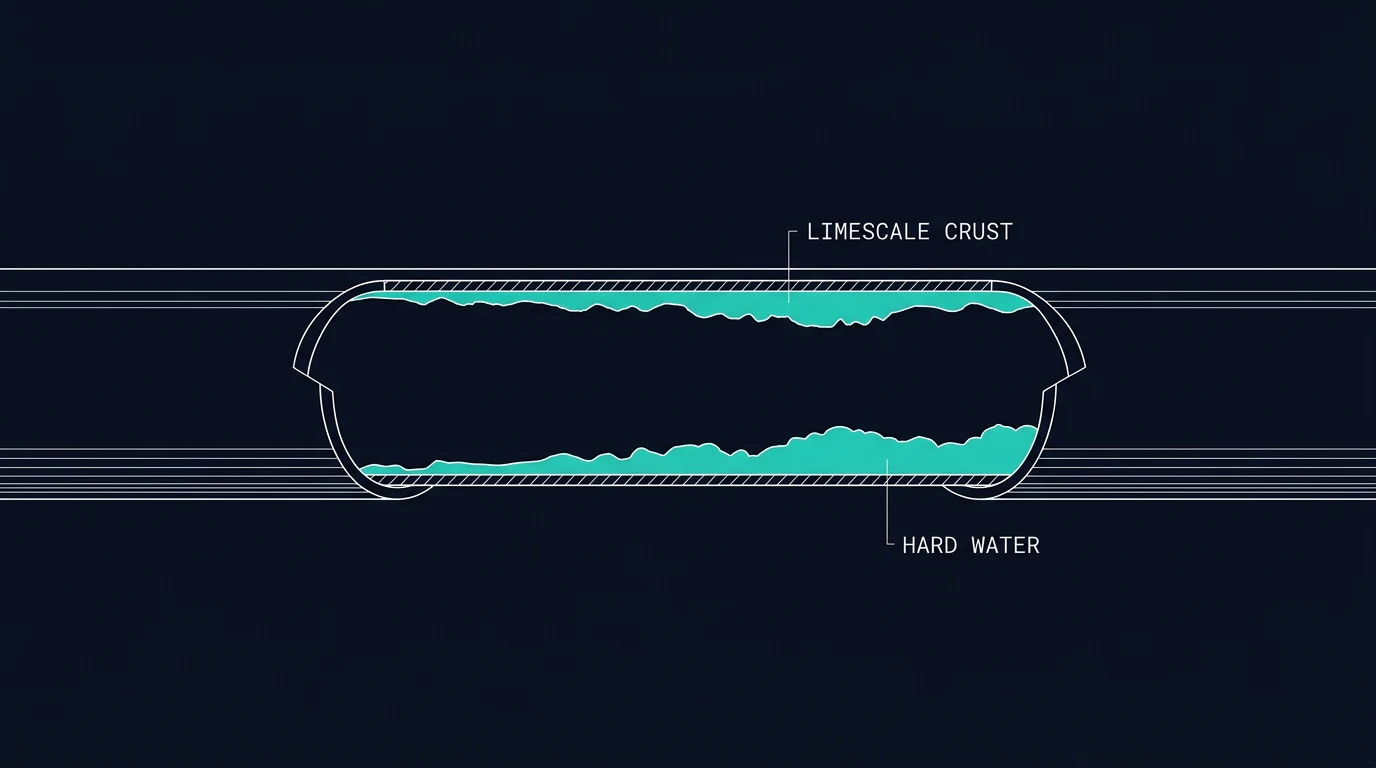
Hard water is water that has dissolved calcium and magnesium from the rock it travelled through. It furs kettles, dulls lather, and makes boilers and heat pumps work against a layer of scale. It is also, according to the regulator, not a health issue. This guide explains what the measurement means, why the pattern across the UK looks the way it does, and how to get the actual figure for a specific address before you buy or rent.
What hardness actually is
Rain is naturally soft. As it soaks through chalk, limestone and other carbonate rock, it picks up calcium and magnesium, and that is what makes water hard. The amount depends on local geology, so it changes from one supply zone to the next, sometimes within a single council area.
Hardness is reported as milligrams of calcium carbonate per litre (mg/l CaCO₃). The Drinking Water Inspectorate (DWI), which regulates drinking water in England and Wales, uses these bands:
| Hardness (mg/l CaCO₃) | Description |
|---|---|
| Up to 100 | Soft |
| 100–150 | Slightly hard |
| 150–200 | Moderately hard |
| 200–300 | Hard |
| Over 300 | Very hard |
The DWI does not set a standard for hardness, calcium or magnesium. That is worth reading twice: there is no limit to breach, because hardness is not treated as a contaminant. The World Health Organization's 2017 guidelines note that water at 200 mg/l or above will produce scale, and water at 100 or below is more corrosive to pipework. Both ends of the range have practical consequences for a building.
Why the south and east are harder
The pattern follows the rock. Much of southern and eastern England sits on chalk and limestone, which is why supplies in and around London, the Home Counties, East Anglia, Lincolnshire and parts of the Midlands tend to measure in the hard to very hard range.
Much of the north and west — Wales, the Lake District, Devon and Cornwall, most of Scotland — sits on older, harder, less soluble rock such as slate, granite and millstone grit, so the water stays soft. Scotland's supplies are mostly soft to moderately soft.
There are local exceptions in both directions, which is why a postcode-level figure from the water company beats any national map.
What hard water does in a building
None of it is a health matter. All of it is an annoyance, and some of it costs money over time.
Kettles, showers and appliances. Scale builds on heating elements. The DWI notes that this shortens their life and makes them less efficient, and that hard water produces less lather from soap, washing-up liquid and washing powder. Shower heads block, glass shower screens cloud, and washing machines and dishwashers need more frequent descaling.
Boilers and heat pumps. This is where hardness matters most for a buyer. The domestic hot water side of a combi boiler or a heat pump cylinder is where scale collects, because that is where fresh hard water is repeatedly heated. A scaled heat exchanger transfers heat less well, so the system runs longer for the same output. How fast this happens depends on the hardness, the volume of hot water used, and the flow temperature. Manufacturers specify water treatment requirements for their own equipment, and warranty terms often refer back to them; check the installation manual for the model in the property, and if a heat pump or a long-guarantee cylinder is already fitted, ask what was specified at commissioning. A heat pump runs on a smaller temperature difference than a gas boiler, so a coating of scale matters more to it.
Pipework and taps. Scale narrows pipes slowly and blocks the aerator on taps. Limescale also marks basins and toilets, which is cosmetic.
Taste and tea. Hard water tastes flatter to some people and leaves a film on the surface of tea brewed in the cup, which the DWI attributes to the air and oils in the tea interacting with the hardness.
The regulator's view on health
The DWI's position is that hardness is not a health concern: it sets no standard, and there is no advice to reduce it for health reasons. The WHO guidelines mention limited evidence of a relationship between hardness and cardiovascular health, related to the calcium and magnesium people get from drinking water; that is a nutritional footnote, not a reason to treat water.
If you have a medical question about your water, the right route is your GP, NHS 111 or the UK Health Security Agency, not a water treatment salesperson.
Where water companies artificially soften water before supply, the DWI recommends they keep a minimum total hardness of 150 mg/l, partly because of that mineral contribution. Softening is not automatically an improvement.
Getting the exact figure for an address
Hardness varies by supply zone, so the reliable answer comes from the company that supplies the property. Every water company publishes water quality data by postcode, and most will send a written report for a specific address on request.
- Find the supplier using the Water UK supplier finder or your council's website.
- Enter the postcode in the supplier's water quality search — most return the hardness or a hardness band for that zone, plus the latest regulatory sampling results.
- If the figure is not published for that postcode, ring or email the company's water quality team and ask for the hardness in mg/l CaCO₃ as calcium carbonate for that supply zone.
- Check the date. Water quality reports are usually annual, and blending from different sources can change hardness over time.
HabitatReport's free postcode check at /check shows what the open national datasets say about the area around a postcode — flood, radon, noise, air quality, broadband and energy ratings. It does not hold a hardness figure, so for this one the water company is the source.
Softeners, filters and the drinking tap
If hardness is high and you want to deal with it, an ion-exchange softener is the established method. It swaps calcium and magnesium for sodium, which stops scale forming. Two things to know:
- Keep an unsoftened drinking supply. The DWI advises keeping an unsoftened outlet for drinking and cooking, and the Water Supply (Water Fittings) Regulations 1999 require installation in a way that preserves one — usually the cold tap at the kitchen sink. Softened water carries more sodium.
- Installation is regulated. Softeners must be fitted to comply with the water fittings regulations, and the Water Regulations Advisory Scheme publishes installation guidance. A softener fitted badly is a plumbing problem, and installation may need notification to the water company.
Point-of-use filters are a different product. They remove some substances but are not a scale treatment, and a filter that is not changed on schedule can become a problem in itself. The DWI publishes consumer guidance on domestic filters and softeners, including warnings about claims made for some devices sold online.
If you are weighing up treatment options for a hard water area, it is worth getting the hardness figure first.
What to ask when you are buying
- The hardness figure for the supply zone, from the water company, with its date.
- The age and service history of the boiler or heat pump, and whether the installer specified water treatment. A system installed to the manufacturer's specification, with a service record, is the useful evidence.
- Whether a softener is fitted, where it is installed, whether an unsoftened drinking tap exists, and who maintains it (salt needs replenishing).
- Any history of low pressure or blocked outlets, which can be scale, but can also be old pipework.
None of this is a reason to walk away from a house. It is a reason to know what you are taking on, and to budget for descaling and servicing rather than for a device that promises more than it can deliver.
What to do next
Get the hardness figure for the postcode from the water company, check the boiler or heat pump service record, and check whether a softener is fitted with an unsoftened drinking tap. Then decide whether treatment is worth it to you. For the area-level picture around an address — the parts that do have open data behind them — start with a free postcode check at /check.
Questions
Is hard water bad for you?
The Drinking Water Inspectorate, which regulates drinking water in England and Wales, sets no standard for hardness, calcium or magnesium, because hardness is not a health concern in itself. Hard water is simply water that has picked up calcium and magnesium as it passed through chalk, limestone or similar rock. Taste and lather are the noticeable differences, not safety.
What is a hard water measurement in mg/l?
Hardness is reported as milligrams of calcium carbonate per litre. The Drinking Water Inspectorate's bands are: up to 100 soft, 100 to 150 slightly hard, 150 to 200 moderately hard, 200 to 300 hard, and above 300 very hard. The World Health Organization notes that water at 200 or above will produce scale, and water at 100 or below is more corrosive to pipework.
Does a water softener make tap water undrinkable?
An ion-exchange softener swaps calcium and magnesium for sodium, so the water tastes different and contains more sodium. The Drinking Water Inspectorate advises keeping an unsoftened outlet for drinking and cooking, and the water fittings regulations require softened supplies to be installed so that an unsoftened drinking supply remains. Installation must comply with the Water Supply (Water Fittings) Regulations 1999.
Can hard water damage a heat pump or boiler?
Scale forms on the hottest surfaces, and the Drinking Water Inspectorate notes that scaling shortens the life of heating elements and makes appliances less efficient. In a heat pump or combi boiler the domestic hot water side is where scale collects. Keeping the flow temperature sensible, and having the system checked as part of normal servicing, matters more than any add-on device.
Do magnetic or electronic scale inhibitors work?
The Drinking Water Inspectorate does not approve or endorse water treatment devices, and a physical conditioner that claims to change the behaviour of scale has no recognised performance standard in the same way as a softener. Treat claims with caution and check that any device is compliant with the water fittings regulations before it is fitted.
Sources
- Drinking Water Inspectorate — Water hardness / hard water
- Drinking Water Inspectorate — Domestic water filters and softeners
- World Health Organization — Guidelines for drinking-water quality (2017)
- The Water Supply (Water Fittings) Regulations 1999
- Water Regulations Advisory Scheme — guidance on ion exchange softener installation
- Water UK — find your water supplier